|
 |
 |
 |
 |
 |
 |
 |
 |
 |

| . |  |
. |
Underwater Drone Works With Men And Dolphins In War Zone
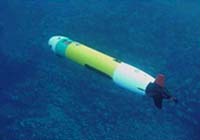
Now here was an awesome alliance: in March, when supply and hospital ships were on their way into Iraq's port of Umm Qasr, and the sea channels had to be cleared of the mines the Iraqis had planted, a group of Marine Corps reconnaissance swimmers, Navy SEALS, Explosive Ordnance divers, dolphins, and underwater drones joined forces. Men and dolphins had worked together before, but this was the first time the unmanned underwater vehicle REMUS was teamed with them in a wartime situation. REMUS (which stands for Remote Environmental Monitoring UnitS) was originally developed to conduct coastal surveys in support of science, and then later improved for military use with support from the Office of Naval Research and the U.S. Special Operations Command. Today, REMUS not only performs rapid environmental surveys, it also functions as an underwater mine reconnaissance tool that operates effectively in shallow water. In Iraq, REMUS was sent out to perform wide area surveys. The dolphins then swam out to inspect potential targets located by REMUS, and the Navy and Marine Corps followed up to perform demolition tasks. REMUS is small and light enough (80 lbs) for two men to handle, and can travel up to 60 miles at speeds between 3-5 knots at depths up to 300 feet. It is programmed using a laptop computer, and can employ sound-emitting transponders as navigational reference beacons, or its onboard computer can autonomously select another more appropriate navigation method to use. Once launched, REMUS carries out its programmed assignment, and then makes its way back to the ship for recovery with the data it has collected. Off Umm Qasr, REMUS was sent out with its side-scan sonar to systematically survey the port channel waters that were seeded with mines. Once the sonar images were processed, dolphins were sent in to inspect potential targets, and report back on what they'd found. In the end, several mines were tagged and destroyed, thanks to the REMUS/dolphin/diver teams, and this allowed coalition forces to bring in nearly 250 tons of badly needed food and materials. "The hard sandy bottom at Umm Qasr was perfect for REMUS, and it was sent out first to do the tedious work of 'mowing the waters.' REMUS works for up to 20 hours without tiring, so it performs well at surveying large areas and locating potential targets, said Christopher von Alt, leader of the WHOI engineering team that developed REMUS for the Navy. "Dolphins, on the other hand, have the intelligence to differentiate between natural and man made objects, so they are our best tool for reacquisition tasks," added Alt. "When these two are combined with diver support, they form the awesome team that was envisioned by ONR over a decade ago." "ONR has long been interested in the development of unmanned undersea vehicles (UUVs)," notes ONR science officer, Tom Swean. "We use them to do pure oceanographic science, and to survey waters before amphibious naval operations are conducted. REMUS works until its batteries need recharging and is many times faster than the human dive teams." The dolphins are trained and handled by the Navy in San Diego, CA. REMUS is now a commercial product available from Hydroid, Inc, of East Falmouth, MA. The next generation REMUS will be a system consisting of three drones that work cooperatively for mine countermeasures in shallow water. Related Links Office of Naval Research SpaceDaily Search SpaceDaily Subscribe To SpaceDaily Express  Hawaiian Telescope Team Makes Debut Discovery
 Kamuela - Jul 02, 2003
Astronomers have observed a young star ringed by a swirling disc that may spin off planets, marking the first published science observation using two linked 10-meter (33- foot) telescopes in Hawaii.
|
|
| |||||||||
| The content herein, unless otherwise known to be public domain, are Copyright 1995-2016 - Space Media Network. All websites are published in Australia and are solely subject to Australian law and governed by Fair Use principals for news reporting and research purposes. AFP, UPI and IANS news wire stories are copyright Agence France-Presse, United Press International and Indo-Asia News Service. ESA news reports are copyright European Space Agency. All NASA sourced material is public domain. Additional copyrights may apply in whole or part to other bona fide parties. Advertising does not imply endorsement, agreement or approval of any opinions, statements or information provided by Space Media Network on any Web page published or hosted by Space Media Network. Privacy Statement All images and articles appearing on Space Media Network have been edited or digitally altered in some way. Any requests to remove copyright material will be acted upon in a timely and appropriate manner. Any attempt to extort money from Space Media Network will be ignored and reported to Australian Law Enforcement Agencies as a potential case of financial fraud involving the use of a telephonic carriage device or postal service. |