| . |  |
. |
| . | |
. |


Opportunity Resets Course To Mars
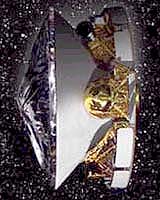
NASA's Opportunity spacecraft made its first trajectory correction maneuver today, a scheduled operation to fine-tune its Mars-bound trajectory, or flight path. The spacecraft and its twin, Spirit, in NASA's Mars Exploration Rover project are carrying field-geology robots for arrival at Mars in January. For the trajectory adjustment, flight team members at NASA's Jet Propulsion Laboratory, Pasadena, Calif., commanded Opportunity to perform a prescribed sequence of thruster firings to adjust the spacecraft's flight path. "It looks like a beautiful burn," said Jim Erickson, Mars Exploration Rover mission manager. "The thrusters fired correctly. We're on course for putting both spacecraft on Mars." The thruster-firing sequence had three main components. First, the entire spacecraft, which is spinning at about 2 rotations per minute, turned to point its spin axis in the direction of the needed course correction. Next, thrusters that accelerate the spacecraft along the direction of that axis burned steadily for about 54 minutes. Afterwards, the spacecraft turned to its next standard cruise attitude. The attitude is changed periodically during the cruise from Earth to Mars to keep the spacecraft's antennas pointed toward Earth and its solar panels facing the Sun. The total trajectory correction maneuver amounted to a velocity change of 16.2 meters per second (36 miles per hour) applied to Opportunity's flight path. This velocity change has two major effects. The first is to move the arrival time at Mars earlier by 1.48 days, to the intended landing date at Meridiani Planum on January 25, 2004, Universal Time (January 24, Pacific Standard Time). The second effect is to move the aimpoint at Mars from one that misses Mars by 340,000 kilometers (211,000 miles) to one that is targeted to enter the atmosphere. At launch, the spacecraft was intentionally targeted to miss Mars so that the upper stage of the Boeing Delta II launch vehicle, traveling on a nearly identical trajectory, would not hit Mars. A key purpose of today's maneuver was to adjust for that initial targeting. As of 6 a.m. Pacific Daylight Time July 19, Opportunity will have traveled 31.5 million kilometers (19.6 million miles) since its July 7 launch. Spirit, launched on June 10, will have traveled 106.9 million kilometers (66.4 million miles). Spirit completed its first trajectory correction maneuver three weeks ago. After arrival, the rovers will examine their landing areas for geological evidence about the history of water on Mars. Related Links Mars Exploration Rovers at JPL Mars Exploration Rovers at Cornell SpaceDaily Search SpaceDaily Subscribe To SpaceDaily Express  Mars Rovers Using Air Force Lab Developed Batteries
 Wright-Patterson - Jul 18, 2003
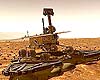
As the Mars exploration rovers "Spirit" and "Opportunity" race toward the Red Planet, part of the Air Force Research Laboratory is soaring with them. The two rovers, expected to touch down and explore opposite sides of Mars in early 2004, are powered by rechargeable lithium-ion batteries researched and developed by experts at the laboratory's propulsion directorate. Spirit and Opportunity will act as robot geologists while on the surface of Mars.
|
|
| |||||||||
| The content herein, unless otherwise known to be public domain, are Copyright 1995-2016 - Space Media Network. All websites are published in Australia and are solely subject to Australian law and governed by Fair Use principals for news reporting and research purposes. AFP, UPI and IANS news wire stories are copyright Agence France-Presse, United Press International and Indo-Asia News Service. ESA news reports are copyright European Space Agency. All NASA sourced material is public domain. Additional copyrights may apply in whole or part to other bona fide parties. Advertising does not imply endorsement, agreement or approval of any opinions, statements or information provided by Space Media Network on any Web page published or hosted by Space Media Network. Privacy Statement All images and articles appearing on Space Media Network have been edited or digitally altered in some way. Any requests to remove copyright material will be acted upon in a timely and appropriate manner. Any attempt to extort money from Space Media Network will be ignored and reported to Australian Law Enforcement Agencies as a potential case of financial fraud involving the use of a telephonic carriage device or postal service. |