|
 |
 |
 |
 |
 |
 |
 |
 |
 |

| . |  |
. |
Study: Ice Belt Encircled Mars' Equator
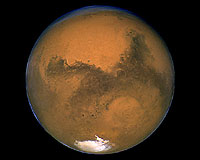
ESA's Mars Express space probe that entered orbit at the end of 2003 may have found evidence of a band of ice that once spanned the Martian equator. Scientists says patterns of glacial activity on the planet may be a relic of an ancient belt of ice that formed about five million years ago due to a change in the tilt of Mars. That shift caused moisture from the poles to be deposited as snow at the equator. The idea is based on work by a team of scientists led by astronomer Jacques Laskar of the Paris Observatory. Laskar's team has shown the tilt of Mars on its axis can vary between 15 degrees and 40 degrees, largely because of its lack of a significant moon. Researchers also found that when Mars' tilt changed to about 35 degrees, moisture trapped at the North and South Poles might have been re-deposited in equatorial regions as snow. Eventually, the poles may have become smaller and a thick belt of ice formed around the tropics. The study was detailed during the American Astronomical Society's Division of Planetary Sciences meeting this week in Cambridge, England. All rights reserved. � 2005 United Press International. Sections of the information displayed on this page (dispatches, photographs, logos) are protected by intellectual property rights owned by United Press International. As a consequence, you may not copy, reproduce, modify, transmit, publish, display or in any way commercially exploit any of the content of this section without the prior written consent of United Press International. Related Links Mars Express SpaceDaily Search SpaceDaily Subscribe To SpaceDaily Express  Water Detection At Gusev Described - Chemical Proof For Two Wet Scenarios
 St Louis MO (SPX) Sep 08, 2005
A large team of NASA scientists, led by earth and planetary scientists at Washington University in St. Louis details the first solid set of evidence for water having existed on Mars at the Gusev crater, exploration site of the rover Spirit.
|
|
| |||||||||
| The content herein, unless otherwise known to be public domain, are Copyright 1995-2016 - Space Media Network. All websites are published in Australia and are solely subject to Australian law and governed by Fair Use principals for news reporting and research purposes. AFP, UPI and IANS news wire stories are copyright Agence France-Presse, United Press International and Indo-Asia News Service. ESA news reports are copyright European Space Agency. All NASA sourced material is public domain. Additional copyrights may apply in whole or part to other bona fide parties. Advertising does not imply endorsement, agreement or approval of any opinions, statements or information provided by Space Media Network on any Web page published or hosted by Space Media Network. Privacy Statement All images and articles appearing on Space Media Network have been edited or digitally altered in some way. Any requests to remove copyright material will be acted upon in a timely and appropriate manner. Any attempt to extort money from Space Media Network will be ignored and reported to Australian Law Enforcement Agencies as a potential case of financial fraud involving the use of a telephonic carriage device or postal service. |