|
 |
 |
 |
 |
 |
 |
 |
 |
 |

| . |  |
. |
Evidence Of Icy Region And Recent Climate Change Observed On Mars
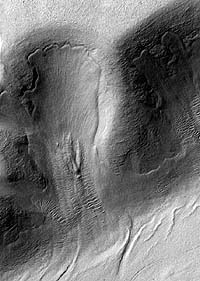
New images of the surface of Mars provide the first direct evidence that the climate of Mars changed during the last 100,000 years, much more recently than the hundreds of millions of years scientists had previously thought, according to Brown University geologist John Mustard. The high- resolution images show evidence of water ice closer to the equator than had previously been observed. Mustard, with graduate student Christopher Cooper and undergraduate Moses Rifkin, wrote about the findings in the July 26 issue of Nature. The images were recorded by the Mars Orbiter Camera aboard NASA's unmanned Mars Global Surveyor. They show a unique surface terrain of pits and hummocks that appears to have been soil once impregnated by water ice. The ice has since evaporated, leaving a five-meter thick mantle of porous terrain that is being broken up by wind and other factors. "Where the mantle is still intact, you could conceive of water ice not far below the surface," Mustard said. "Where it's broken into pits and hummocks, the water is gone." The geologically young terrain was observed in two bands north and south of the equator at 30 to 60 degrees latitude. The location is significant because it shows that ice in the soil was once present as close to the equator as 30 degrees and as recently as 100,000 years, while previous observations had shown that ice had been present in the polar regions. Due to climate change, it now appears the icy region moved from the planet's poles to nearer its equator, and has now retreated to the poles, the most recent of probably many such cycles, Mustard said. "While we have always thought the climate of Mars has changed over time, this is direct evidence for change. And that change fits with the theory of periodic climate change, similar to the change that causes the ice ages on Earth," Mustard said. "Maybe we don't have to go to the poles to find water ice. It's easier for a spacecraft to survive at the equator," Mustard said. Related Links SpaceDaily Search SpaceDaily Subscribe To SpaceDaily Express  Water Shaped Martian Landscape in Recent Times Claims Hydrologist
 Tucson - July 23, 2001
Scientists have known for decades that Mars, at least in its ancient past, has had a considerable amount of water. But when Mars Global Surveyor began mapping the Red Planet in sharp detail early in 1999, it disclosed startling evidence that water has shaped martian landforms within the past 10 million years.
|
|
| |||||||||
| The content herein, unless otherwise known to be public domain, are Copyright 1995-2016 - Space Media Network. All websites are published in Australia and are solely subject to Australian law and governed by Fair Use principals for news reporting and research purposes. AFP, UPI and IANS news wire stories are copyright Agence France-Presse, United Press International and Indo-Asia News Service. ESA news reports are copyright European Space Agency. All NASA sourced material is public domain. Additional copyrights may apply in whole or part to other bona fide parties. Advertising does not imply endorsement, agreement or approval of any opinions, statements or information provided by Space Media Network on any Web page published or hosted by Space Media Network. Privacy Statement All images and articles appearing on Space Media Network have been edited or digitally altered in some way. Any requests to remove copyright material will be acted upon in a timely and appropriate manner. Any attempt to extort money from Space Media Network will be ignored and reported to Australian Law Enforcement Agencies as a potential case of financial fraud involving the use of a telephonic carriage device or postal service. |