|
 |
 |
 |
 |
 |
 |
 |
 |
 |

| . |  |
. |
More Evidence For Volcanism and Water Release On Mars
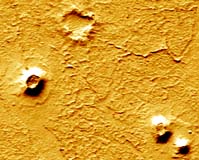
In their search for water and possible life on Mars, scientists are turning to new data generated by the Mars Orbiter Camera (MOC) images and Mars Orbiter Laser Altimeter (MOLA) topography from the Mars Global Surveyor (MGS) spacecraft. The Elysium and Amazonis Planitia regions of Mars have come under particularly intensive study because of their recently proposed young ages (10-100 million years ago or less). Several different recent studies have respectively shown that: some of the volcanic flows were likely emplaced over ice-rich ground; at least one flow originated from the long rift-type vents of the Cerberus Fossae; and recent floods also originated from the vent system, perhaps depositing water in the shallow subsurface for later volcanic flows to interact with. But the capstone of this work is the discovery by NASA/Goddard Earth Science and Technology Center scientist Susan Sakimoto and colleagues that the new data reveals regionally extensive lava eruptions from the same vent system as the water. While earlier data hints at this conclusion, Sakimoto's evidence provides the strongest support yet that these volcanic and hydrologic events indeed are both young and related in origins, and could perhaps still occur on Mars in the future. Sakimoto presented these November 8, at the Geological Society of America's annual meeting in Boston. "Based on the convergence of fluvial and volcanic features in the topography, evidence for their interaction, their interlinked deposits, flow model results of the eruption rates, and the episodic nature of the eruption style and their youth, it is clear to us that the potential for continuing eruptions in the NEXT several tens of million of years ought to be good," Sakimoto said. "These are absolutely beautiful examples of plains volcanism! The ramifications include a potential for ongoing thermal and water sources for sustaining or starting an environment compatible with life into recent Martian geologic time (and possibly into the present) and enhanced understanding of the plains- style eruption type in a slightly different planetary environment." Related Links Geological Society of America SpaceDaily Search SpaceDaily Subscribe To SpaceDaily Express  Geological Society of America
Goddard Space Flight Center Subglacial Volcanoes On Mars  Edinburgh - June 27, 2001
The search for liquid water is key for finding habitable environments on Mars today--places where prebiotic chemistry and/or life could still be going on. Not surprisingly, the mantra, "Follow the Water," has become a primary driver in NASA's new Mars Program. Water in liquid form is regarded as essential for life. Active Volcanism On Mars And The Search For Water  Reykjavik - May 10, 2001
The Tharsis Montes on Mars of Arsia Mons, Pavonis Mons and Ascraeus Mons, are gigantic volcano triplets of a youthful age with possible evidence of recent volcanism. Based on crater impact rates, Johann Helgason theorizes that a major fluvial erosive event took place within the past 10 million years.
|
|
| |||||||||
| The content herein, unless otherwise known to be public domain, are Copyright 1995-2016 - Space Media Network. All websites are published in Australia and are solely subject to Australian law and governed by Fair Use principals for news reporting and research purposes. AFP, UPI and IANS news wire stories are copyright Agence France-Presse, United Press International and Indo-Asia News Service. ESA news reports are copyright European Space Agency. All NASA sourced material is public domain. Additional copyrights may apply in whole or part to other bona fide parties. Advertising does not imply endorsement, agreement or approval of any opinions, statements or information provided by Space Media Network on any Web page published or hosted by Space Media Network. Privacy Statement All images and articles appearing on Space Media Network have been edited or digitally altered in some way. Any requests to remove copyright material will be acted upon in a timely and appropriate manner. Any attempt to extort money from Space Media Network will be ignored and reported to Australian Law Enforcement Agencies as a potential case of financial fraud involving the use of a telephonic carriage device or postal service. |