|
 |
 |
 |
 |
 |
 |
 |
 |
 |

| . |  |
. |
An Odyssey Of Martian Science
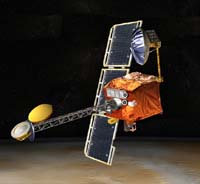
NASA's 2001 Mars Odyssey spacecraft is carrying a suite of scientific instruments designed to tell us what makes up the Martian surface, and provide vital information about potential radiation hazards for future human explorers. "Odyssey represents a milestone in our exploration of Mars, We expect Odyssey to remove some of the uncertainties and help us plan where we must go with future missions.," said Ed Weiler, Associate Administrator for Space Science at NASA Headquarters. Launched April 7 from Cape Canaveral, Odyssey is NASA's first mission to Mars since the loss of two spacecraft in 1999. Other than our own Moon, Mars has attracted more spacecraft exploration attempts than any other object in the solar system, and no other planet has proved as daunting to success. Of the 30 missions sent to Mars by three countries over 40 years, fewer than one-third have been successful. The Odyssey team conducted vigorous reviews and incorporated "lessons learned" in the mission plan. "The project team has looked at the people, processes, and design to understand and reduce our mission risk," said George Pace, 2001 Mars Odyssey project manager at NASA's Jet Propulsion Laboratory (JPL). "We haven't been satisfied with just fixing the problems from the previous missions. We've been trying to anticipate and prevent other things that could jeopardize the success of this mission." Odyssey is part of NASA's Mars Exploration Program, a long-term robotic exploration initiative launched in 1996 with Mars Pathfinder and Mars Global Surveyor. "Odyssey will help identify and ultimately target those places on Mars where future rovers and landers must visit to unravel the mysteries of the red planet," said Jim Garvin, lead scientist for NASA's Mars Exploration Program. NASA's latest explorer carries three scientific instruments to map the chemical and mineralogical makeup of Mars: a thermal-emission imaging system (THEMIS), a gamma ray spectrometer (GRS) and a Martian radiation environment experiment (MARIE). THEMIS will map the planet with high-resolution thermal images and give scientists an increased level of detail to help them understand how the mineralogy of the planet relates to the landforms they see. The part of Odyssey's imaging system that takes pictures in visible light will see objects with a clarity that fills the gaps between the Viking orbiter cameras of the 1970s and today's high-resolution images from Mars Global Surveyor. Like a virtual shovel digging into the surface, Odyssey's gamma ray spectrometer (GRS) will allow scientists to peer into the upper few centimeters of Mars's crust to measure many elements, including the amount of hydrogen that exists. Because hydrogen is most likely present in the form of water-ice, the spectrometer will be able to measure permanent ground ice and how that changes with the seasons. "For the first time at Mars, we will have a spacecraft that is equipped to find evidence for present near-surface water and to map mineral deposits from past water activity," said Steve Saunders, 2001 Mars Odyssey project scientist at JPL. "Despite the wealth of information from previous missions, exactly what Mars is made of is not fully known, so this mission will give us a basic understanding about the chemistry and mineralogy of the surface." The Martian radiation environment experiment, MARIE, will be the first to examine radiation levels at Mars as they relate to the potential hazards faced by future astronauts. The experiment will take data on the way to Mars and in orbit around the red planet. After completing its primary mission, the Odyssey orbiter will provide a communications relay for future American and international landers, including NASA's Mars Exploration Rovers, scheduled for launch in 2003. Adapted from earlier NASA Space Science Report Related Links Odyssey 2001 Mission Home SpaceDaily Search SpaceDaily Subscribe To SpaceDaily Express  Odyssey Set To Burn Into Mars Orbit
 Pasadena - Oct 19, 2001
After 200 days of travel and more than 460 million kilometers (about 285 million miles) logged on its odometer, NASA's 2001 Mars Odyssey spacecraft will fire its main engine for the first and only time Oct. 23 and put itself into orbit around the red planet.
|
|
| |||||||||
| The content herein, unless otherwise known to be public domain, are Copyright 1995-2016 - Space Media Network. All websites are published in Australia and are solely subject to Australian law and governed by Fair Use principals for news reporting and research purposes. AFP, UPI and IANS news wire stories are copyright Agence France-Presse, United Press International and Indo-Asia News Service. ESA news reports are copyright European Space Agency. All NASA sourced material is public domain. Additional copyrights may apply in whole or part to other bona fide parties. Advertising does not imply endorsement, agreement or approval of any opinions, statements or information provided by Space Media Network on any Web page published or hosted by Space Media Network. Privacy Statement All images and articles appearing on Space Media Network have been edited or digitally altered in some way. Any requests to remove copyright material will be acted upon in a timely and appropriate manner. Any attempt to extort money from Space Media Network will be ignored and reported to Australian Law Enforcement Agencies as a potential case of financial fraud involving the use of a telephonic carriage device or postal service. |