|
 |
 |
 |
 |
 |
 |
 |
 |
 |

| . |  |
. |
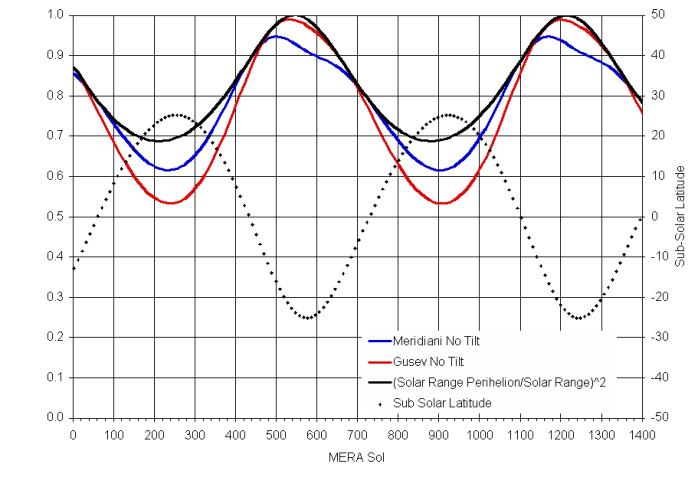
Chart Shows Variation In Solar Power Available For Mars Rovers
This chart illustrates the variation in available solar power for each of NASA's twin Mars Exploration Rovers over the course of approximately two Mars years. Two factors affect the amount of available power: the tilt of Mars' axis and the eccentricity of the Mars' orbit about the sun. The horizontal scale is the number of Martian days (sols) after the Jan. 4, 2004, (Universal Time) landing of Spirit at Mars' Gusev Crater. The vertical scale on the right indicates the amount of available solar power as a ratio of the amount available at the equator when Mars is closest to the sun (perihelion). The red line indicates power availability at Spirit's landing site (Gusev). The blue line indicates power availability at Opportunity's landing site (Meridiani). The vertical scale on the right applies to the dotted line, indicating the latitude north or south of Mars' equator where the noon sun is overhead at different times of the Martian year.
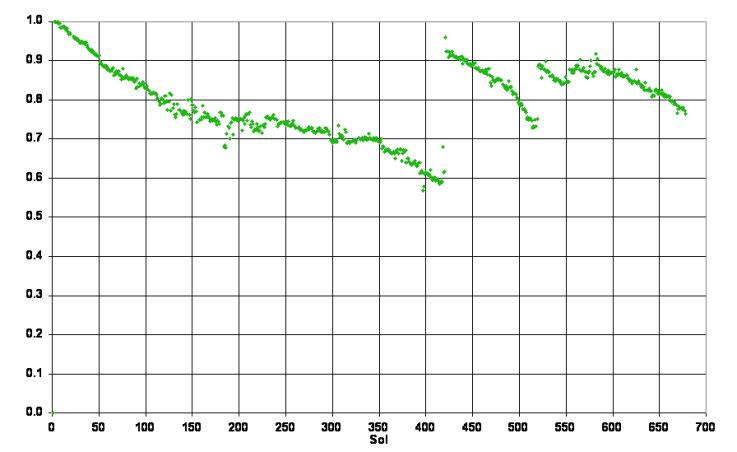
Solar-Panel Dust Accumulation and Cleanings
This graph shows the effects of those panel-cleaning events on the amount of electricity generated by Spirit's solar panels. The horizontal scale is the number of Martian days (sols) after Spirit's Jan. 4, 2005, (Universal Time) landing on Mars. The vertical scale indicates output from the rover's solar panels as a fraction of the amount produced when the clean panels first opened. Note that the gradual declines are interrupted by occasional sharp increases, such as a dust-cleaning event on sol 420. Related Links Mars Rovers at JPL Mars Rovers at Cornell SpaceDaily Search SpaceDaily Subscribe To SpaceDaily Express  Mars Rovers Continue To Explore And Amaze One Year Later
 Pasadena CA (SPX) Dec 06, 2005
NASA's durable twin Mars rovers have successfully explored the surface of the mysterious red planet for a full Martian year (687 Earth days). Opportunity starts its second Martian year Dec. 11; Spirit started a new year three weeks ago. The rovers' original mission was scheduled for only three months.
|
|
| ||||||||||
| The content herein, unless otherwise known to be public domain, are Copyright 1995-2016 - Space Media Network. All websites are published in Australia and are solely subject to Australian law and governed by Fair Use principals for news reporting and research purposes. AFP, UPI and IANS news wire stories are copyright Agence France-Presse, United Press International and Indo-Asia News Service. ESA news reports are copyright European Space Agency. All NASA sourced material is public domain. Additional copyrights may apply in whole or part to other bona fide parties. Advertising does not imply endorsement, agreement or approval of any opinions, statements or information provided by Space Media Network on any Web page published or hosted by Space Media Network. Privacy Statement All images and articles appearing on Space Media Network have been edited or digitally altered in some way. Any requests to remove copyright material will be acted upon in a timely and appropriate manner. Any attempt to extort money from Space Media Network will be ignored and reported to Australian Law Enforcement Agencies as a potential case of financial fraud involving the use of a telephonic carriage device or postal service. |