|
 |
 |
 |
 |
 |
 |
 |
 |
 |

| . |  |
. |
Methane Found In Desert Soils Bolsters Theories That Life Could Exist On Mars
Evidence of methane-producing organisms can be found in inhospitable soil environments much like those found on the surface of Mars, according to experiments undertaken by scientists and students from the Keck School of Medicine of the University of Southern California and the University of Arkansas and published online in the journal Icarus. These results, they say, provide ample impetus for similar "biodetection experiments" to be considered for future missions to Mars. "Methane-producing organisms are the ones most likely to be found on Mars," notes Joseph Miller, Ph.D., associate professor of cell and neurobiology at the Keck School and one of the study's lead researchers. "And, in fact, methane was detected on Mars last year." Methane is considered to be a biological signature for certain living organisms that metabolize organic matter under conditions of low or no oxygen. Terrestrial methanogens (methane-producers) are typically found in environments largely protected from atmospheric oxygen, such as peat bogs, oceanic methane ices and anoxic levels of the ocean. But they had not previously been detected in an arid desert environment. To see if methane could be found in Mars-like soil, the investigators collected soil and vapor samples from the arid environment of the Mars Desert Research Station in Utah, and then compared them with vapor samples taken from the Idaho High Desert and soil samples from Death Valley, the Arctic and the Atacama desert in Chile. Three of five vapor samples from the Utah site showed the presence of methane; there was no methane found in any of the vapor samples from Idaho. Similarly, while five of 40 soil samples from Utah produced methane after the addition of growth medium to the samples-indicating that the methane was being given off by a biological organism, most likely a bacterium-none of the other soil samples showed signs of methane production. Finding methane in the Utah desert is no guarantee that methane-producers exist on Mars, admits Miller, who has previously analyzed data from the Viking Lander missions and found that soil samples taken in the 1970s from the Martian surface exhibited a circadian rhythm in what appeared to be nutrient metabolism, much like that present in terrestrial microbes. However, Miller says, this recent experiment does provide "proof of principle [in that] it improves the case that such bacteria can and might exist on the Martian surface." And that, he adds, surely warrants further investigation during future missions to Mars. In conclusion, the researchers write, "The detection of methane, apparently of biological origin, in terrestrial desert regolith bodes well for future biodetection experiments in at least partially analogous Martian environments." Related Links University of Southern California Keck School of Medicine SpaceDaily Search SpaceDaily Subscribe To SpaceDaily Express  Frozen Microbes Reveal How To Test For Martian Life
 Washington DC (SPX) Oct 05, 2005
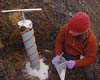
"We tested equipment that we are developing to look for life on Mars and discovered a rare and complex microbial community living in blue ice vents inside a frozen volcano," remarked Hans E.F. Amundsen of Physics of Geological Processes (PGP) at the University of Oslo, Norway, and leader of the international AMASE team.
|
|
| |||||||||
| The content herein, unless otherwise known to be public domain, are Copyright 1995-2016 - Space Media Network. All websites are published in Australia and are solely subject to Australian law and governed by Fair Use principals for news reporting and research purposes. AFP, UPI and IANS news wire stories are copyright Agence France-Presse, United Press International and Indo-Asia News Service. ESA news reports are copyright European Space Agency. All NASA sourced material is public domain. Additional copyrights may apply in whole or part to other bona fide parties. Advertising does not imply endorsement, agreement or approval of any opinions, statements or information provided by Space Media Network on any Web page published or hosted by Space Media Network. Privacy Statement All images and articles appearing on Space Media Network have been edited or digitally altered in some way. Any requests to remove copyright material will be acted upon in a timely and appropriate manner. Any attempt to extort money from Space Media Network will be ignored and reported to Australian Law Enforcement Agencies as a potential case of financial fraud involving the use of a telephonic carriage device or postal service. |