|
 |
 |
 |
 |
 |
 |
 |
 |
 |

| . |  |
. |
Concepts and Approaches in Mars Exploration
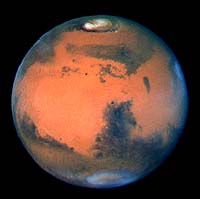
Cameron Park - Sept. 12, 2000 NASA has now essentially decided -- in accord with the recommendations of most of the participants at last July's Houston conference on "Concepts and Approaches in Mars Exploration" -- that the form of the Mars program needs to be drastically changed, in the direction of extensive reconaisssance of the planet before landing sites are picked out for unmanned sample-return missions, But what should the details of the new program be? Actually, another question comes before that one: to what extent SHOULD the new Mars program be planned out in advance? Several Conference participants pointed out that too much advance planning too far into the future can lead to serious trouble itself, for two reasons. The first is that -- when near-future missions depend on the success of a mission -- its failure can foul up the whole program's schedule for years in advance. We saw this happen when the failure of Mars Polar Lander forced the cancellation of the similar 2001 Mars Surveyor Lander, despite the fact that it had been almost completely built. The second is that -- from the start of its exploration -- the planet Mars has thrown one major surprise after another at us. The flybys of the Sixties had convinced most scientists that Mars was a desolate world that had never had much air or any liquid water on its surface -- but Mariner 9's 1971 orbital survey revealed large networks of ancient valleys apparently carved by liquid water. The 1976 Viking landers discovered what appear to be powerful oxidizing compounds in Mars' soil -- whose origin, and even identity, remain puzzling, and which thoroughly fouled up interpretation of the life-detection experiments which had been carefully planned out on that mission for years in advance. And Mars Global Surveyor's ongoing detailed orbital survey of Mars has thrown a whole series of surprises at us -- most of which still remain puzzling. A (by no means complete) list includes the apparent near-absence of carbonates or other water-weathered surface minerals such as one would expect if early Mars did have liquid water on its surface; the fact that most areas of its surface that looked smooth in the Viking Orbiter photos have turned out to be covered with parallel grooves and furrows a few dozen meters wide, carved by some erosive process that we don't understand; and -- most recently -- the discovery of what looks like evidence of recent eruptions of liquid water from just below Mars' surface, where its current existence was thought to be impossible. Any Mars exploration strategy must include the ability to adjust its form fairly quickly in response to such new revelations, which could turn it topsy-turvy. (That discovery of possible near-surface water eruptions -- announced only a few months ago -- is already having a major impact on NASA's future Mars plans.) For these reasons, several Conference participants -- including David Paige, Candace Hansen and M.I. Richardson -- urged that the Mars program take on a form similar to the Discovery Program for general Solar System exploration, in which NASA periodically releases Announcements of Opportunity (setting only cost and time constraints), various separate scientific teams respond by proposing entire unified mission candidates, and NASA then selects the best of them. This format would allow total flexibility from moment to moment in planning the Mars program. Quoting Richardson: "The best strategy of exploration is... to have no strategy except to be as well prepared as possible for the next step ahead and to be fully aware of the available options." But there are some limits to this approach as well, for Mars. The current Discovery program is a "scattershot" affair in which probes are aimed at dozens of different potential scientific targets all over the Solar System, so that the order in which missions are launched has virtually no effect on later missions. In the case of Mars, though, we do have an overall top program goal -- determining whether early Mars supported life, or at least had an environment that could have supported life -- which we would like to advance toward as rapidly as possible; and this does require some advance planning of the overall sequence of missions. Also, there are a number of very important new technologies which are unquestionably crucial for Mars exploration, and which need to be developed and tested as quickly as possible. Beyond the long-range rovers now firmly set for 2003, these include:
One well-received attempt was made at the Conference to design a fairly detailed program for U.S. Mars exploration over the next 15 years or so, by the Ames Research Center's Geoffrey Briggs and Christopher McKay. Their plan allows considerable elasticity in the details of mission order -- but it does emphasize the importance of carrying out both sweeping reconnaissance of Mars' surface to look for the best landing sites, and tests of the various technologies we will require before we start launching either sample-return missions or attempts to drill deep into Mars' surface. In Part 3 of this report, I'll describe their plan.
Related Links  Cameron Park - September 5, 2000 Cameron Park - September 5, 2000NASA is tentatively scheduled to announce its radically redesigned program for Mars exploration in October -- and in preparation for this, they are accepting mission concept proposals from industry.
|
|
| |||||||||
| The content herein, unless otherwise known to be public domain, are Copyright 1995-2016 - Space Media Network. All websites are published in Australia and are solely subject to Australian law and governed by Fair Use principals for news reporting and research purposes. AFP, UPI and IANS news wire stories are copyright Agence France-Presse, United Press International and Indo-Asia News Service. ESA news reports are copyright European Space Agency. All NASA sourced material is public domain. Additional copyrights may apply in whole or part to other bona fide parties. Advertising does not imply endorsement, agreement or approval of any opinions, statements or information provided by Space Media Network on any Web page published or hosted by Space Media Network. Privacy Statement All images and articles appearing on Space Media Network have been edited or digitally altered in some way. Any requests to remove copyright material will be acted upon in a timely and appropriate manner. Any attempt to extort money from Space Media Network will be ignored and reported to Australian Law Enforcement Agencies as a potential case of financial fraud involving the use of a telephonic carriage device or postal service. |