| . |  |
. |
| . | |
. |


Canada Will Land Instrument On Mars To Study Weather
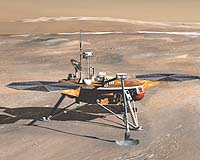
The Canadian Space Agency announced a final contribution of $6 million to Canadian firm MDA Space Missions to build a fully integrated weather station, known as MET, for the 2007 launch of NASA's Phoenix Lander Mission to Mars. Phoenix will study climate at the Red Planet's northern latitudes, the geological history of water, and the potential of the soil to support life. As an innovative application of lidar, one of Canada's advanced space technologies, the Canadian weather station will be the first ever to have operated from the surface of another planet. "Canada has an exciting role in the international Mars expedition and our scientific and industrial space expertise gains recognition by contributing this key experiment," remarked Dr. Vicky Hipkin, Program Scientist for Planetary Exploration at the Canadian Space Agency. "MET will assist in the Phoenix mission's study of water. Discoveries about the severe weather on Mars are very important to future manned missions to the planet." MDA Space Missions of Brampton, Ontario, is the prime contractor for the MET station, which will include instruments to measure pressure and temperature, and assess climate patterns in Mars' northern plains. Optech of Toronto, Ontario, is providing lidar expertise to MDA as a sub-contractor. The lidar instrument will analyze clouds, fog, and dust plumes in the lower atmosphere. The Canadian science team is led by the Department of Earth and Space Science and Engineering at York University. "Landing close to the icy north polar cap in spring will let us study a remarkable feature of the martian climate. Each spring a significant mass of water ice sublimates from the polar cap forming seasonal ice clouds," said Dr. Peter Taylor, Director of the program at York University. "There are lots of questions about where this water ice ends up and how stable the current ice cap is. Observing these clouds and dust storm features with the Phoenix lidar will provide an exciting new insight into these aspects of the climate of Mars." The Canadian Space Agency is providing $19.5 million for the design and building of the MET station for NASA's first Scout Mission. Related Links SpaceDaily Search SpaceDaily Subscribe To SpaceDaily Express  Deciphering Mars: The Future
 Moffett Field (SPX) Sep 27, 2005
The Mars Science Laboratory, to be launched in 2009, is regarded as a keystone mission that marks the transition to the next decade of exploration.
|
|
| |||||||||
| The content herein, unless otherwise known to be public domain, are Copyright 1995-2016 - Space Media Network. All websites are published in Australia and are solely subject to Australian law and governed by Fair Use principals for news reporting and research purposes. AFP, UPI and IANS news wire stories are copyright Agence France-Presse, United Press International and Indo-Asia News Service. ESA news reports are copyright European Space Agency. All NASA sourced material is public domain. Additional copyrights may apply in whole or part to other bona fide parties. Advertising does not imply endorsement, agreement or approval of any opinions, statements or information provided by Space Media Network on any Web page published or hosted by Space Media Network. Privacy Statement All images and articles appearing on Space Media Network have been edited or digitally altered in some way. Any requests to remove copyright material will be acted upon in a timely and appropriate manner. Any attempt to extort money from Space Media Network will be ignored and reported to Australian Law Enforcement Agencies as a potential case of financial fraud involving the use of a telephonic carriage device or postal service. |