|
 |
 |
 |
 |
 |
 |
 |
 |
 |

| . |  |
. |
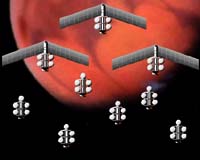
Twenty Years From Now On Mars
Since Wernher von Braun first sketched out his Marsprojekt in 1946, a succession of designs and mission profiles were seriously studied in the United States and the Soviet Union. By the late 1960's Von Braun had come to favour nuclear thermal rocket powered expeditions, while Korolev's design bureau decided that nuclear electric propulsion was the way to go. All such work stopped in both countries in the 1970's, after the cancellation of the Apollo program in the United States and the N1 booster in the Soviet Union. Work resumed in the 1980's, led in America by private advocacy groups, and in the Soviet Union by Glushko, who saw the new Energia heavy-lift booster as the means of reaching Mars. In the late 1980's there was even a brief 'Race to Mars', with both sides putting forward designs. This unexpected revival of the space race ended with the collapse of the Soviet Union and the scrapping of the Energia booster. Despite press enthusiasm, such a project never had any high-level political support in either country. Despite pronouncements by a succession of American presidents that a manned expedition to Mars was a long-term national goal, there has never been the political will to provide the funding necessary for such an enterprise. By 2005 NASA had funded a dizzying array of studies and iterations, all basically trading launch mass from low earth orbit for time and risk of mission failure. No compelling concept emerged. The safest way would be for an expedition to Mars being the result of a robust space infrastructure (heavy lift boosters, aerobraking space tugs, nuclear thermal engines, long-term cryogenic propellant storage) already developed and in place. But there was no prospect of such an infrastructure being funded...
SpaceDaily Search SpaceDaily Subscribe To SpaceDaily Express  Geological Finding Shows Mars To Be A Complex Planet That Continues To Evolve
 Tempe AZ (SPX) Jul 07, 2005
Mars is a rocky planet with an ancient volcanic past, but new findings show the planet is more complex and active than previously believed � at least in certain places.
|
|
| |||||||||
| The content herein, unless otherwise known to be public domain, are Copyright 1995-2016 - Space Media Network. All websites are published in Australia and are solely subject to Australian law and governed by Fair Use principals for news reporting and research purposes. AFP, UPI and IANS news wire stories are copyright Agence France-Presse, United Press International and Indo-Asia News Service. ESA news reports are copyright European Space Agency. All NASA sourced material is public domain. Additional copyrights may apply in whole or part to other bona fide parties. Advertising does not imply endorsement, agreement or approval of any opinions, statements or information provided by Space Media Network on any Web page published or hosted by Space Media Network. Privacy Statement All images and articles appearing on Space Media Network have been edited or digitally altered in some way. Any requests to remove copyright material will be acted upon in a timely and appropriate manner. Any attempt to extort money from Space Media Network will be ignored and reported to Australian Law Enforcement Agencies as a potential case of financial fraud involving the use of a telephonic carriage device or postal service. |