|
 |
 |
 |
 |
 |
 |
 |
 |
 |

| . |  |
. |
MIT Researchers Visit Mars On Earth
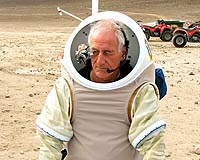
Cambridge MA (SPX) Nov 22, 2005 At 75 degrees north latitude, Devon Island lies high above the Arctic Circle, a few hundred miles from the magnetic North Pole. A true polar desert, it is also the largest uninhabited island on Earth. But the reach of MIT extends even here. This past summer, a research team from MIT's Department of Aeronautics and Astronautics established a semi-permanent shelter at the NASA Haughton-Mars Base. Supported by a NASA grant on interplanetary supply chain management, the team went to Devon Island because the existing base infrastructure, combined with the remote and barren location, makes it ideal for studying logistics strategies that could be used in planning exploration strategies to the moon and Mars. The principal investigators for the project are Professors Olivier de Weck and David Simchi-Levi. "Haughton-Mars Base provides an excellent analogy to lunar and Mars exploration," said de Weck. "This is primarily due to its remoteness, the time-varying nature of the transportation links and its thin supply line." The MIT team also included former NASA astronaut and MIT Professor Jeffrey Hoffman and seven students. The Haughton-Mars Project is an international, interdisciplinary field research project sponsored by NASA and the Canadian Space Agency, focused on the scientific study of the Haughton Crater - a 40-kilometer-wide geological structure formed more than 38 million years ago by the impact of a large meteor. Chosen in part for its remoteness and similarity to Mars terrain, the site also serves as an analogue or "mock" exploration base, where an array of exploration-related engineering and technology experiments are tested. Another expedition goal was to establish an MIT presence at the Haughton base for future educational and research activities. "The Haughton-Mars Project Devon Island base gives us a unique opportunity to conduct experimental tests of some of the ideas we've been developing for lunar and Martian exploration," Hoffman said. "We're hoping this becomes a permanent MIT facility." The MIT team compiled a complete inventory of materials at the base, including such key items as food and fuel. It also experimented with modern logistics technologies, such as radio frequency identification, that autonomously manage and track assets, with the ultimate goal of creating a "smart exploration base" that could increase safety and save astronauts and explorers precious time. Source: MIT News Office Results from the MIT expedition are now being processed. These findings will form the basis for continued work on interplanetary logistics through this fall. Related Links SpaceDaily Search SpaceDaily Subscribe To SpaceDaily Express  Mars Society Australia Gets Stage Three Funding For Starchaser Rover
 Sydney, Australia (SPX) Oct 28, 2005
The UK Space Tourism Company, Starchaser Industries through their Director, Paul Young has generously donated another UKP 20,000 (AU$ 46,723) for Stage 3 of the construction of the Starchaser Marsupial Rover project.
|
|
| |||||||||
| The content herein, unless otherwise known to be public domain, are Copyright 1995-2016 - Space Media Network. All websites are published in Australia and are solely subject to Australian law and governed by Fair Use principals for news reporting and research purposes. AFP, UPI and IANS news wire stories are copyright Agence France-Presse, United Press International and Indo-Asia News Service. ESA news reports are copyright European Space Agency. All NASA sourced material is public domain. Additional copyrights may apply in whole or part to other bona fide parties. Advertising does not imply endorsement, agreement or approval of any opinions, statements or information provided by Space Media Network on any Web page published or hosted by Space Media Network. Privacy Statement All images and articles appearing on Space Media Network have been edited or digitally altered in some way. Any requests to remove copyright material will be acted upon in a timely and appropriate manner. Any attempt to extort money from Space Media Network will be ignored and reported to Australian Law Enforcement Agencies as a potential case of financial fraud involving the use of a telephonic carriage device or postal service. |