|
 |
 |
 |
 |
 |
 |
 |
 |
 |

| . |  |
. |
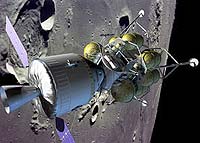
NASA Selects Team To Build Lunar Lander
NASA's Deputy Associate Administrator for the Exploration Systems Mission Directorate Doug Cooke announced Friday the selection of NASA's Marshall Space Flight Center, Huntsville, Ala., and Goddard Space Flight Center, Greenbelt, Md., to lead a team in the development of a lunar lander spacecraft. The lander is tentatively planned for launch as early as 2010. It will demonstrate the ability for precision landings at targeted locations on the moon; evaluate landing zone environment; and determine if lunar resources can support a sustained human presence. "This mission will have as a primary objective to determine whether there is water-ice in the permanently dark areas within craters in the moon's polar regions. The existence of water-ice has important implications in living off the land when we return with human explorers," Cooke said. "The lunar lander will test critical automated descent and precision landing capabilities needed for human landings, including surface hazard avoidance during landing. The discoveries from this mission and the data it collects will play a vital role in humans returning to the moon and living there for extended periods," he added. The Robotic Lunar Exploration Program (RLEP) program is intended to provide a series of robotic missions to support human exploration. The lunar lander spacecraft is the second RLEP mission. The Lunar Reconnaissance Orbiter (LRO) is the first mission developed under the RLEP. The LRO is being built at Goddard and is scheduled for launch in 2008. The orbiter will carry six instruments that will map and photograph the lunar surface, search for surface ice deposits, and investigate space radiation. Related Links SpaceDaily Search SpaceDaily Subscribe To SpaceDaily Express  SMART-1 Set For More Lunar Science
 Darmstadt, Germany (ESA) Sep 27, 2005
ESA's SMART-1 mission in orbit around the Moon has had its scientific lifetime extended by ingenious use of its solar-electric propulsion system (or 'ion engine').
|
|
| |||||||||
| The content herein, unless otherwise known to be public domain, are Copyright 1995-2016 - Space Media Network. All websites are published in Australia and are solely subject to Australian law and governed by Fair Use principals for news reporting and research purposes. AFP, UPI and IANS news wire stories are copyright Agence France-Presse, United Press International and Indo-Asia News Service. ESA news reports are copyright European Space Agency. All NASA sourced material is public domain. Additional copyrights may apply in whole or part to other bona fide parties. Advertising does not imply endorsement, agreement or approval of any opinions, statements or information provided by Space Media Network on any Web page published or hosted by Space Media Network. Privacy Statement All images and articles appearing on Space Media Network have been edited or digitally altered in some way. Any requests to remove copyright material will be acted upon in a timely and appropriate manner. Any attempt to extort money from Space Media Network will be ignored and reported to Australian Law Enforcement Agencies as a potential case of financial fraud involving the use of a telephonic carriage device or postal service. |