|
 |
 |
 |
 |
 |
 |
 |
 |
 |

| . |  |
. |
NASA Grant To Tap Lunar Resources
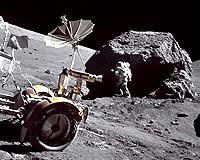
Florida Tech associate professor of chemical engineering, Dr. Jonathan Whitlow, received a grant of nearly $50,000 from NASA to develop computer models that can lead to producing propellants from the lunar regolith, or rock mantle. He will collaborate with NASA Kennedy Space Center, NASA Johnson Space Center, and the Colorado School of Mines. "Developing these lunar elements into propellants in-situ can improve the economics of exploring the moon and other planetary bodies," said Whitlow. Oxygen is abundant on the moon in the form of metal oxides in the lunar soil. In addition, small amounts of other resources exist, such as hydrogen, nitrogen and carbon, which have been deposited by the solar wind. "The in-situ processing of the lunar soil to produce propellants is a challenge of chemical engineering," said Whitlow. He will be developing predictive models for various processing steps involved in the resource recovery on the moon. Florida Tech offers bachelor's, master's and doctoral degrees in chemical engineering. Related Links Florida Tech Colorado School of Mines SpaceDaily Search SpaceDaily Subscribe To SpaceDaily Express  Apollo 11 Experiment Still Going Strong After 35 Years
 Pasadena CA (JPL) Jul 22, 2004
It was the summer of '69. Director John Schlesinger's "Midnight Cowboy" had won the Oscar for Best Picture; the Rolling Stones' newly released "Honky Tonk Women" was climbing the charts; 400,000 people were gearing up to attend Woodstock�and America landed on the Moon, making "one giant leap for mankind."
|
|
| |||||||||
| The content herein, unless otherwise known to be public domain, are Copyright 1995-2016 - Space Media Network. All websites are published in Australia and are solely subject to Australian law and governed by Fair Use principals for news reporting and research purposes. AFP, UPI and IANS news wire stories are copyright Agence France-Presse, United Press International and Indo-Asia News Service. ESA news reports are copyright European Space Agency. All NASA sourced material is public domain. Additional copyrights may apply in whole or part to other bona fide parties. Advertising does not imply endorsement, agreement or approval of any opinions, statements or information provided by Space Media Network on any Web page published or hosted by Space Media Network. Privacy Statement All images and articles appearing on Space Media Network have been edited or digitally altered in some way. Any requests to remove copyright material will be acted upon in a timely and appropriate manner. Any attempt to extort money from Space Media Network will be ignored and reported to Australian Law Enforcement Agencies as a potential case of financial fraud involving the use of a telephonic carriage device or postal service. |