|
 |
 |
 |
 |
 |
 |
 |
 |
 |

| . |  |
. |
Solar Activity Linked To Whale Strandings: Study
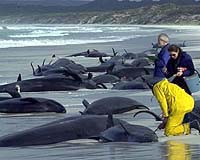
Surges of solar activity may cause whales to run aground, possibly by disrupting the creatures' internal compass, German scientists suggest. University of Kiel researchers Klaus Vaneslow and Klaus Ricklefs looked at sightings of sperm whales found beached in the North Sea between 1712 and 2003. They then compared this record with another set of historical data - astronomers' observations of sunspots, which is an indicator of solar radiation. More whale strandings occurred when the sun's activity is high, they found. The sun experiences cycles of activity which range from eight to 17 years, with 11 years being the average. Short cycles are linked with periods of high energy output, while long cycles are believed to be low energy. Changes in levels of solar radiation have a big effect on Earth's magnetic field. The most notable events are gouts of highly-charged particles, called solar flares, that cause shimmering lights, called aurorae, in the magnetic fields in polar regions. Big solar flares can also disrupt telecommunications and power lines and knock out delicate electronic circuitry on satellites. The researchers found that of the 97 stranding events reported around the coastal countries of the North Sea over the 291 years, 90 percent occurred when the sun cycles was below average in duration. The Vanselow team speculate that whales may have a magnetic sense of orientation like pigeons, which are believed to navigate thanks to small magnetic crystals on their beaks. What could happen is that male sperm whales, following a migratory path from the Norwegian Sea, could become disorientated by minor changes in the geomagnetic field as they enter the North Sea, the pair suggest. "In this shallow-shelf sea with a contourless seabed, often with soft bottom sediments, their deep-water sonar and other adaptations to their normal habitat may not function properly," they say. Previous studies have suggested that powerful marine sonar could be to blame for whale strandings by messing up the whales' sense of direction and depth. An October 2003 study by British and Spanish marine pathologists, based on autopsies carried out on 10 beaked whales that beached in the Canary Islands a few hours after a Spanish-led naval task force passed by, found that the cetaceans had suffered a mortal attack of the "bends." Tissue dissection showed that the whales' livers and other internal organs were filled with gas bubbles, and smaller blood vessels had been literally blown apart from inside. The injuries were consistent with decompression sickness, in which nitrogen gas, absorbed into the blood stream, expands quickly as a submerged mammal rises to the surface, forming bubbles that can clot or breach blood vessels. The latest study is published in the Journal of Sea Research, published by the Netherlands-based Elsevier group. All rights reserved. � 2004 Agence France-Presse. Sections of the information displayed on this page (dispatches, photographs, logos) are protected by intellectual property rights owned by Agence France-Presse. As a consequence, you may not copy, reproduce, modify, transmit, publish, display or in any way commercially exploit any of the content of this section without the prior written consent of Agence France-Presse. Related Links University of Kiel SpaceDaily Search SpaceDaily Subscribe To SpaceDaily Express  Map Of Life On Earth Could Be Used On Mars
 St Louis MO (SPX) May 12, 2005
A geologist from Washington University in St. Louis is developing new techniques to render a more coherent story of how primitive life arose and diverged on Earth � with implications for Mars.
|
|
| |||||||||
| The content herein, unless otherwise known to be public domain, are Copyright 1995-2016 - Space Media Network. All websites are published in Australia and are solely subject to Australian law and governed by Fair Use principals for news reporting and research purposes. AFP, UPI and IANS news wire stories are copyright Agence France-Presse, United Press International and Indo-Asia News Service. ESA news reports are copyright European Space Agency. All NASA sourced material is public domain. Additional copyrights may apply in whole or part to other bona fide parties. Advertising does not imply endorsement, agreement or approval of any opinions, statements or information provided by Space Media Network on any Web page published or hosted by Space Media Network. Privacy Statement All images and articles appearing on Space Media Network have been edited or digitally altered in some way. Any requests to remove copyright material will be acted upon in a timely and appropriate manner. Any attempt to extort money from Space Media Network will be ignored and reported to Australian Law Enforcement Agencies as a potential case of financial fraud involving the use of a telephonic carriage device or postal service. |