|
 |
 |
 |
 |
 |
 |
 |
 |
 |

| . |  |
. |
Russian Proton Launches US ComSat PAS-10
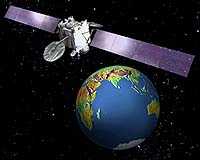
Russia successfully launched a Proton-K rocket carrying a US-owned communications satellite early Tuesday, Russian news agencies reported. The PanAmSat-10 satellite, which would ensure the communications flow for several countries of the Indian Ocean area, was launched from the Baikonur space centre in Kazakhstan on Tuesday at 0111 GMT, the Interfax news agency reported. The satellite was successfully brought into orbit some 228 kilometres above Earth at 0121 GMT, space officials said. PAS-10, the sixth Boeing-built satellite delivered to PanAmSat in 17 months, will provide international services from its orbital position of 68.5 degrees East longitude. The launch is scheduled for 7:11 a.m. at the Baikonur launch site (1:11 a.m. GMT and at 6:11 p.m. PDT on May 14). The satellite was built by Boeing Satellite Systems (BSS), a unit of Boeing. "With the launch of PAS-10, Boeing Satellite Systems will have delivered the third of three satellites ordered in 1999 to support PanAmSat's international expansion plan," said Randy Brinkley, president of BSS. "Overall, PAS-10 is the 17th satellite that BSS has built for the PanAmSat fleet, and we are proud of this longstanding relationship. And, after PAS-10, we are looking forward to the launch of Galaxy IIIC, a Boeing 702 spacecraft that is scheduled to launch in this year's third quarter." "PAS-10 marks PanAmSat's sixth new satellite in less than 18 months, demonstrating our strong commitment to build the most robust fleet available to serve the needs of our long-term and valued customers," said R. Douglas Kahn, PanAmSat's president and chief executive officer. "When PAS-10 goes into operation it will serve in the development of new and more advanced broadcast, high-speed data and Internet services across Europe, Africa, Asia and the Middle East." The high-power, 9,600-watt satellite features leading technologies from Boeing, including high-efficiency gallium arsenide solar cells. The communications payload consists of 48 active transponders, 24 in C-band powered by 55-watt traveling wave tube amplifiers (TWTAs), and 24 in Ku-band, powered by 98-watt TWTAs. At launch the spacecraft will weigh 8,314 pounds (3,772 kilograms). Once its solar wings and antennas are deployed in orbit, PAS-10 will measure 86 feet in length and 23 feet in width. PanAmSat will expand its global fleet to 22 spacecraft by year-end 2001. Related LinksSpaceDaily Search SpaceDaily Subscribe To SpaceDaily Express  ESA May Consider Soyuz Launches From Kourou Space Center In November
 Moscow (Interfax) April 24, 2001
The European Space Agency (ESA) in November may consider the possibility of launching Russian Soyuz launch vehicles from the Kourou space center in French Guyana, French Minister of Research Roger-Gerard Schwarzenberg told a Tuesday news conference at the Interfax central office.
|
|
| |||||||||
| The content herein, unless otherwise known to be public domain, are Copyright 1995-2016 - Space Media Network. All websites are published in Australia and are solely subject to Australian law and governed by Fair Use principals for news reporting and research purposes. AFP, UPI and IANS news wire stories are copyright Agence France-Presse, United Press International and Indo-Asia News Service. ESA news reports are copyright European Space Agency. All NASA sourced material is public domain. Additional copyrights may apply in whole or part to other bona fide parties. Advertising does not imply endorsement, agreement or approval of any opinions, statements or information provided by Space Media Network on any Web page published or hosted by Space Media Network. Privacy Statement All images and articles appearing on Space Media Network have been edited or digitally altered in some way. Any requests to remove copyright material will be acted upon in a timely and appropriate manner. Any attempt to extort money from Space Media Network will be ignored and reported to Australian Law Enforcement Agencies as a potential case of financial fraud involving the use of a telephonic carriage device or postal service. |