|
 |
 |
 |
 |
 |
 |
 |
 |
 |

| . |  |
. |
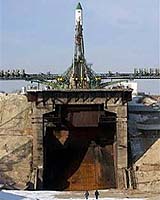
Progress Cargo Craft On Its Way to Space Station
An unmanned Russian cargo craft lifted off Monday from the Baikonur Cosmodrome in Kazakhstan with about 2.3 tons of supplies and equipment for the International Space Station and its Expedition 10 crew, Commander Leroy Chiao and Flight Engineer Salizhan Sharipov. ISS Progress 17 launched on time at 2:09 p.m. EST. It reached orbit in less than 10 minutes. Moments later, automatic commands deployed its solar arrays and navigational antennas. Engine firings are scheduled later Monday to adjust the Progress' orbit for an automated docking March 2 at 3:15 p.m. EST to the aft port of the Station's Zvezda Service Module. Among the spacecraft's 4,631 pounds of cargo are 386 pounds of propellant, 242 pounds of oxygen and air, and 1,071 pounds of water. Among equipment aboard the new Progress are cameras and lenses to be used to photograph thermal protection tiles of Discovery as the return to flight mission approaches the station and a new heat exchanger for the U.S. Quest Airlock that should allow resumption of U.S. spacewalks from the Station. Also aboard are 86 containers of food, an additional 160-day supply for the Station. Spare parts for the Russian Elektron oxygen-producing system and the Vozdukh carbon-dioxide removal system are among the cargo items, as are spare parts and supplies for the Station's toilet. The Progress 16 cargo ship, which had been at the Station since Christmas Day, was undocked on Sunday, clearing the aft port of Zvezda for the new Progress. Filled with trash and discarded items, Progress 16 will be commanded to deorbit by Russian flight controllers after about 10 days of engineering tests. It will burn up in the Earth's atmosphere soon afterward. Related Links SpaceDaily Search SpaceDaily Subscribe To SpaceDaily Express  ISS Crew Install, Test New Remote Control Robotic Arm Software
 Houston TX (SPX) Feb 28, 2005
The crew members aboard the International Space Station are winding down a week that saw them preparing for the arrival of a new cargo spacecraft and helping achieve a milestone in Station robotics operations that has the potential for long-term exploration applications.
|
|
| |||||||||
| The content herein, unless otherwise known to be public domain, are Copyright 1995-2016 - Space Media Network. All websites are published in Australia and are solely subject to Australian law and governed by Fair Use principals for news reporting and research purposes. AFP, UPI and IANS news wire stories are copyright Agence France-Presse, United Press International and Indo-Asia News Service. ESA news reports are copyright European Space Agency. All NASA sourced material is public domain. Additional copyrights may apply in whole or part to other bona fide parties. Advertising does not imply endorsement, agreement or approval of any opinions, statements or information provided by Space Media Network on any Web page published or hosted by Space Media Network. Privacy Statement All images and articles appearing on Space Media Network have been edited or digitally altered in some way. Any requests to remove copyright material will be acted upon in a timely and appropriate manner. Any attempt to extort money from Space Media Network will be ignored and reported to Australian Law Enforcement Agencies as a potential case of financial fraud involving the use of a telephonic carriage device or postal service. |