|
 |
 |
 |
 |
 |
 |
 |
 |
 |

| . |  |
. |
New ISS Crew Arm Themselves For Practical Training
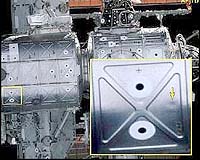
NASA Astronaut Leroy Chiao is getting his arms around his job as Expedition 10 commander with a little help from the International Space Station's robotic arm. As is the case with every Station crew, practice sessions with the Station's 58-foot robotic arm, Canadarm2, are scheduled early in the mission to exercise the arm and provide practical training for astronauts. Monday, Chiao, in the Destiny Laboratory, used the arm to give engineers in the Mission Evaluation Room of Mission Control video of a protective panel on the outside the module. A possible indentation was seen there in imagery from the most recent Space Shuttle mission to the Station in November 2002 (STS-113/11A). Chiao positioned the arm, so cameras could zoom in on the area. The video helped engineers determine the indentation was not caused by a micrometeoroid or debris strike. The flat spot on the lab shield appeared to be similar to flattened areas seen in shields on the Unity module. Engineering analysis of the imagery showed these flat spots could occur on the forward and aft triangles of the shields possibly as the result of temperature changes. The shields' protective function and fit is not affected. The robotic arm practice was one of the duties he and Flight Engineer Salizhan Sharipov performed this week, as they neared the one-month mark in space since their launch Oct. 14. Earlier today, Chiao again took command of the robot arm and moved it into position to allow its cameras to view the relocation of the crew's Soyuz spacecraft, a maneuver scheduled for Nov. 29. The crew will fly the Soyuz from the Pirs Docking Compartment to a docking port on the Zarya Control Module. The move will clear the Pirs module for two Russian spacewalks in 2005. While the crew continued routine housekeeping and exercise chores, scientific research work continued as well. The focus of attention this week was the Binary Colloidal Alloy Test (BCAT), which investigates long-term behavior of particles suspended in various liquids such as ink, paint and milk, in microgravity. Chiao worked with the experiment twice this week to assist investigators in determining what types of colloids should be studied by future crews. Ultimately, the data could help in development of new products for the communications and computer industries. At midweek, Chiao tried to fix a faulty U.S. spacesuit pump that caused a lack of cooling as discovered in testing during Expedition 9 earlier this year. The work was halted when a small washer-shaped shim could not be found. Flight controllers ended the search yesterday and will evaluate the next course of action. The U.S. suits are not scheduled for use until Space Shuttle flights resume. A new shim may be delivered to the Station aboard the next Progress resupply spacecraft in December. Yesterday, a circuit breaker tripped aboard the Station that had been powering several pieces of crew equipment. The circuit breaker remains off while the crew and ground teams plan to check the equipment that had been powered. The equipment includes a laptop, the cycle ergometer and a light. Those items will be tested to ensure no problems with them caused the breaker to trip. Today, the crew took photos of the setup for engineers on the ground. Among activities next week will be a reboost of the Station's altitude, a maneuver performed periodically to maintain the complex's orbit. Information about crew activities on the Space Station, future launch dates and Station sighting opportunities from Earth, is available on the Internet at: Related Links ISS at NASA SpaceDaily Search SpaceDaily Subscribe To SpaceDaily Express  Magnetic Storm Affects Space Station Orbit
 Moscow (UPI) Nov 12, 2004
The orbit of the International Space Station will be corrected after a drop of 4.2 miles because of a fierce magnetic storm, Russian media reported Friday. The magnetic storm registered this week is one of the heaviest in the history of geomagnetic observations.
|
|
| |||||||||
| The content herein, unless otherwise known to be public domain, are Copyright 1995-2016 - Space Media Network. All websites are published in Australia and are solely subject to Australian law and governed by Fair Use principals for news reporting and research purposes. AFP, UPI and IANS news wire stories are copyright Agence France-Presse, United Press International and Indo-Asia News Service. ESA news reports are copyright European Space Agency. All NASA sourced material is public domain. Additional copyrights may apply in whole or part to other bona fide parties. Advertising does not imply endorsement, agreement or approval of any opinions, statements or information provided by Space Media Network on any Web page published or hosted by Space Media Network. Privacy Statement All images and articles appearing on Space Media Network have been edited or digitally altered in some way. Any requests to remove copyright material will be acted upon in a timely and appropriate manner. Any attempt to extort money from Space Media Network will be ignored and reported to Australian Law Enforcement Agencies as a potential case of financial fraud involving the use of a telephonic carriage device or postal service. |