|
 |
 |
 |
 |
 |
 |
 |
 |
 |

| . |  |
. |
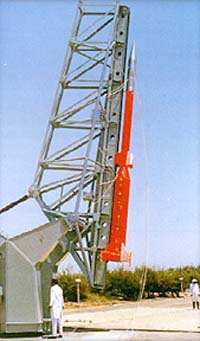
Sriharikota - March 27, 2000 - ISRO has started an intensive scientific campaign, involving launch of 40 Rohini Sounding Rockets (RH 200) along with launches of high-altitude balloons from Sriharikota and low altitude balloons from Thiruvananthapuram to study gravity waves in the atmosphere. Ground-based observations using National Mesosphere Stratosphere Troposphere Radar Facility (NMRF) at Gadanki near Tirupati are also being made under this scientific campaign which began on February 21, 2000 and will continue till the first week of April 2000. The instruments carried on board the Rohini sounding rockets and the balloons measures the height structures of winds and waves in the atmosphere. The data is used to determine the momentum fluxes associated with various types of waves that are present in the equatorial atmosphere such as the Kelvin waves (having periods of 10 to 20 days) and Rossby gravity waves (having periods of 4 to 5 days) in the troposphere (up to about 16 km height), stratosphere (16 to 50 km) and mesosphere (50 t0 80 km). These waves are believed to be the major driving forces for the evolution of quasi-biennial oscillations in the atmosphere. The knowledge about these quasi biennial oscillations is important for understanding the interactions with meteorological phenomena at lower altitudes such as El-Nino and La-Nina. The Rohini sounding rockets which reach an altitude of about 70 km, along with balloons that reach altitudes of 25 to 30 km, will collect data for 40 consecutive days. Extended periods of observations by NMRF and Rayleigh Lidar that is collocated with NMRF at Gadanki near Tirupati are also being undertaken to delineate shorter period gravity waves. It is for the first time that such an elaborate scientific campaign is being undertaken. Space Physics Laboratory of Vikram Sarabhai Space Centre, Kerala University, National Mesosphere-Stratosphere-Troposphere Radar Facility (NMRF) and Sri Venkateswara University besides several meteorologists are participating in the campaign.
Indo Space In Focus
INDO SPACE
|
|
| |||||||||
| The content herein, unless otherwise known to be public domain, are Copyright 1995-2016 - Space Media Network. All websites are published in Australia and are solely subject to Australian law and governed by Fair Use principals for news reporting and research purposes. AFP, UPI and IANS news wire stories are copyright Agence France-Presse, United Press International and Indo-Asia News Service. ESA news reports are copyright European Space Agency. All NASA sourced material is public domain. Additional copyrights may apply in whole or part to other bona fide parties. Advertising does not imply endorsement, agreement or approval of any opinions, statements or information provided by Space Media Network on any Web page published or hosted by Space Media Network. Privacy Statement All images and articles appearing on Space Media Network have been edited or digitally altered in some way. Any requests to remove copyright material will be acted upon in a timely and appropriate manner. Any attempt to extort money from Space Media Network will be ignored and reported to Australian Law Enforcement Agencies as a potential case of financial fraud involving the use of a telephonic carriage device or postal service. |