|
 |
 |
 |
 |
 |
 |
 |
 |
 |

| . |  |
. |
Ocean Tides Once Spread Massive Icebergs: Study
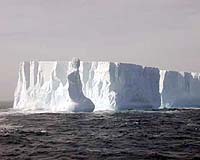
Labrador Sea ocean tides dislodged huge Arctic icebergs thousands of years ago, carrying gigantic ice-rafted debris across the ocean and contributing to the ice age's deep freeze, say an international team of university researchers. The study, published in the November issue of Nature, is the first to suggest that ocean tides contributed to enigmatic Heinrich events, a phenomenon where colossal discharges of icebergs periodically flowed into the North Atlantic from about 60,000 to 10,000 years ago. The events occurred during the deep throes of the ice age and the new study shows that tides added to the chill by breaking gigantic icebergs from the ice sheet covering northern Canada. "These findings provide a link between ocean tides, ice sheets and ocean circulation and a measure of the sensitivity of climate during the last ice age," says University of Toronto physics professor Jerry Mitrovica, a co-author of the study. "This sensitivity is important to understand, because the connection between changes in ocean circulation and future climate remains a matter of great interest." To track ancient tides, Mitrovica, lead author Professor Brian Arbic of Princeton University and a team of researchers used a state-of-the-art computer model that captured current open-ocean tidal variances with an unprecedented 92 per cent accuracy. They then inputted ice-age simulations of sea-level changes over time. "The results showed that the tides were highest in the Labrador Sea at the same time the Heinrich events occurred," says Mitrovica. "We can safely assume that the tides played a key role in breaking the ice and launching the icebergs into the ocean." Mitrovica is careful to note that ocean circulation is just one piece of the present-day climatic change puzzle. "As an example, the Antarctic ice sheet weakens due to warming and huge blocks have broken off where tides are highest. Future climatic changes involve many different factors, but it's important to note that in our ice-age past tides defined the weak spot and acted as a catalyst for large climate events." Related Links Princeton SpaceDaily Search SpaceDaily Subscribe To SpaceDaily Express  Edging Out Of Endurance
 Pasadena CA (JPL) Dec 07, 2004
Opportunity has completed its super-high-resolution imaging and other remote sensing operations from the base of "Burns Cliff," collecting more than 985 megabits of telemetry. Due to the large number of observations, the data management team has been working hard to manage available memory. Opportunity has now begun its journey out of "Endurance Crater."
|
|
| |||||||||
| The content herein, unless otherwise known to be public domain, are Copyright 1995-2016 - Space Media Network. All websites are published in Australia and are solely subject to Australian law and governed by Fair Use principals for news reporting and research purposes. AFP, UPI and IANS news wire stories are copyright Agence France-Presse, United Press International and Indo-Asia News Service. ESA news reports are copyright European Space Agency. All NASA sourced material is public domain. Additional copyrights may apply in whole or part to other bona fide parties. Advertising does not imply endorsement, agreement or approval of any opinions, statements or information provided by Space Media Network on any Web page published or hosted by Space Media Network. Privacy Statement All images and articles appearing on Space Media Network have been edited or digitally altered in some way. Any requests to remove copyright material will be acted upon in a timely and appropriate manner. Any attempt to extort money from Space Media Network will be ignored and reported to Australian Law Enforcement Agencies as a potential case of financial fraud involving the use of a telephonic carriage device or postal service. |