|
 |
 |
 |
 |
 |
 |
 |
 |
 |

| . |  |
. |
Saving Private Hubble
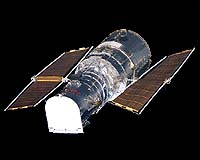
To study neighbouring planets, distant stars and galaxies light years away, astronomers have constantly strived to improve their instruments. But for years, our Earth's atmosphere has veiled their observations. In April 1990, a new telescope opened a new window for space science. Today Euronews looks at the Hubble Space Telescope. In April 1990, the launch of the Hubble telescope opened a new window for space science. The 11 tonne space observatory, orbiting our planet at an altitude of nearly 600 km, has allowed astronomers throughout the world to considerably increase our knowledge of the Universe. The telescope was conceived and built jointly by NASA and ESA. It was designed to last 20 years, with regular servicing missions by the Shuttle. Astronauts have thus been four times to repair and upgrade its instruments. The scientific community has never ceased to praise this exceptional tool. Hubble images have also greatly contributed to a wider understanding of space-based astronomy. Its colourful views of convoluted galaxies where stars are being born, of distant star formations, even close up views of neighbouring planets have struck the public imagination. The Columbia tragedy in February 2003 had unexpected consequences for Hubble. Following the accident enquiry, flights to the International Space Station became the priority for Shuttle missions when they resume next year. A Hubble mission has also been considered too risky. So the planned servicing mission to change its batteries and gyroscopes before 2008 was cancelled. An initial decision by NASA concerning Hubble was met by an outcry from its users, the world's scientific community and a wider public. All the more because Hubble's successor, the James Webb Space Telescope, will only be launched in 2011. NASA has since agreed to consider proposals for an entirely robotic mission both to repair the telescope and to ensure that it can safely be brought back to Earth when its day finally comes. Proposals have been called for and a decision on whether to go ahead to save Hubble is expected in the coming weeks. Related Links Hubble at ESA SpaceDaily Search SpaceDaily Subscribe To SpaceDaily Express  O'Keefe Hangs Tough On Hubble
 Washington (UPI) Jun 23, 2004
If there were any lingering doubts NASA Administrator Sean O'Keefe meant what he said last January about vetoing a space shuttle repair mission for the Hubble Space Telescope, those doubts were eliminated Tuesday.
|
|
| |||||||||
| The content herein, unless otherwise known to be public domain, are Copyright 1995-2016 - Space Media Network. All websites are published in Australia and are solely subject to Australian law and governed by Fair Use principals for news reporting and research purposes. AFP, UPI and IANS news wire stories are copyright Agence France-Presse, United Press International and Indo-Asia News Service. ESA news reports are copyright European Space Agency. All NASA sourced material is public domain. Additional copyrights may apply in whole or part to other bona fide parties. Advertising does not imply endorsement, agreement or approval of any opinions, statements or information provided by Space Media Network on any Web page published or hosted by Space Media Network. Privacy Statement All images and articles appearing on Space Media Network have been edited or digitally altered in some way. Any requests to remove copyright material will be acted upon in a timely and appropriate manner. Any attempt to extort money from Space Media Network will be ignored and reported to Australian Law Enforcement Agencies as a potential case of financial fraud involving the use of a telephonic carriage device or postal service. |