
 |
 |
 |
 |
 |
 |
 |
 |
 |
 |

| . |  |
. |
Hubble Looks Through A Gravity Lens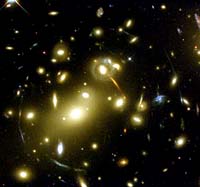 Washington - January 24, 2000 - Hubble has imaged a giant, cosmic magnifying glass, a massive cluster of galaxies called Abell 2218 that resides in the constellation Draco, some 2 billion light-years from Earth. The cluster is so massive that its enormous gravitational field deflects light rays passing through it, much as an optical lens bends light to form an image.
This phenomenon, called gravitational lensing, magnifies, brightens, and distorts images from faraway objects. The cluster's magnifying powers provides a powerful "zoom lens" for viewing distant galaxies that could not normally be observed with the largest telescopes. This useful phenomenon has produced the arc-shaped patterns found throughout the Hubble picture. These "arcs" are the distorted images of very distant galaxies, which lie 5 to 10 times farther than the lensing cluster. This distant population existed when the universe was just a quarter of its present age. Through gravitational lensing these remote objects are magnified, enabling scientists to study them in more detail. This analysis provides a direct glimpse of how star-forming regions are distributed in remote galaxies and yields other clues to the early evolution of galaxies. The picture is dominated by spiral and elliptical galaxies. Resembling a string of tree lights, the biggest and brightest galaxies are members of the foreground cluster. Researchers are intrigued by a tiny red dot just left of top center. This dot may be an extremely remote object made visible by the cluster's magnifying powers. Further investigation is needed to confirm the object's identity. The Hubble telescope first viewed this cluster in 1994, producing one of the most spectacular demonstrations of gravitational lensing up to that time. Scientists who analyzed that black-and-white picture discovered more than 50 remote, young galaxies. Hubble's latest multicolor image of the cluster will allow astronomers to probe in greater detail the internal structure of these early galaxies. The color picture already reveals several arc-shaped features that are embedded in the cluster and cannot be easily seen in the black-and-white image. The colors in this picture yield clues to the ages, distances, and temperatures of stars, the stuff of galaxies. Blue pinpoints hot young stars. The yellow-white color of several of the galaxies represents the combined light of many stars. Red identifies cool stars, old stars, and the glow of stars in distant galaxies. This view is only possible by combining Hubble's unique image quality with the rare lensing effect provided by the magnifying cluster. The picture was taken Jan. 11 to 13, 2000, with the Wide Field and Planetary Camera 2. Credits: NASA, ESA, Andrew Fruchter (STScI), and the ERO team (STScI)
SPACE SCOPES
|
|
| ||||||||
| The content herein, unless otherwise known to be public domain, are Copyright 1995-2016 - Space Media Network. All websites are published in Australia and are solely subject to Australian law and governed by Fair Use principals for news reporting and research purposes. AFP, UPI and IANS news wire stories are copyright Agence France-Presse, United Press International and Indo-Asia News Service. ESA news reports are copyright European Space Agency. All NASA sourced material is public domain. Additional copyrights may apply in whole or part to other bona fide parties. Advertising does not imply endorsement, agreement or approval of any opinions, statements or information provided by Space Media Network on any Web page published or hosted by Space Media Network. Privacy Statement All images and articles appearing on Space Media Network have been edited or digitally altered in some way. Any requests to remove copyright material will be acted upon in a timely and appropriate manner. Any attempt to extort money from Space Media Network will be ignored and reported to Australian Law Enforcement Agencies as a potential case of financial fraud involving the use of a telephonic carriage device or postal service. |
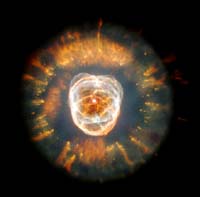 Greenbelt - January 11, 2000 - The Hubble Space Telescope has captured a majestic view of a planetary nebula, the glowing remains of a dying, Sun-like star. This stellar relic, first spied by William Herschel in 1787, is nicknamed the "Eskimo" Nebula (NGC 2392) because, when viewed through ground-based telescopes, it resembles a face surrounded by a fur parka.