|
 |
 |
 |
 |
 |
 |
 |
 |
 |

| . |  |
. |
Antarctica's Frozen Past May Hold Clues To Future Climate
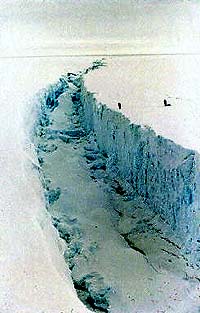
To learn how the Earth's climate has varied in the past and how it might change in the future, university scientist Christopher Shuman is willing to travel to the ends of the earth. Currently, he is braving cold and winds at the bottom end Antarctica. There, preserved in the ice, he expects to find evidence of atmospheric conditions on Earth hundreds of years ago, before the onset of industrialization. Shuman, who also has conducted research near the top of the world in Greenland, now is at McMurdo Station on Ross Island. This base is the operations hub for all U.S. scientific work in Antarctica. In a few days he will embark on a nearly month-long-traverse of 750 miles of the western Antarctic's polar desert with nine other members of this year's U.S. International Trans- Antarctic Science Expedition (ITASE). This will be his second visit as part of ITASE, a project to drill and bring back Antarctic ice cores for analysis. In an interview just before he left, Shuman, a researcher in the university's new Earth System Science Interdisciplinary Center, explained that studying these ice cores allows scientists to examine historical fluctuations in atmospheric temperature and other atmospheric conditions. Antarctica is ideal as a place to obtain ice core samples for such studies because it is a continent were none of the moderate amounts of snow that fall each year melts. "Our goal is to take ice cores ... that have layers that correspond to the year by year accumulation," Shuman said. "These layers preserve a record of the atmospheric conditions present over hundreds and in some cases even hundreds of thousands of years." However, he noted that in Antarctica survival is first and science second. "You have to be prepared for the minimum expectation, which is that you don't get any real complex science done but you do come home alive." Related Links A Science Diary From Antarctica SpaceDaily Search SpaceDaily Subscribe To SpaceDaily Express  150-year Global Ice Record Reveals Major Warming Trend
Madison - September 11, 2000  From sources as diverse as newspaper archives, transportation ledgers and religious observances, scientists have amassed lake and river ice records spanning the Northern Hemisphere that show a steady 150-year warming trend.
|
|
| |||||||||
| The content herein, unless otherwise known to be public domain, are Copyright 1995-2016 - Space Media Network. All websites are published in Australia and are solely subject to Australian law and governed by Fair Use principals for news reporting and research purposes. AFP, UPI and IANS news wire stories are copyright Agence France-Presse, United Press International and Indo-Asia News Service. ESA news reports are copyright European Space Agency. All NASA sourced material is public domain. Additional copyrights may apply in whole or part to other bona fide parties. Advertising does not imply endorsement, agreement or approval of any opinions, statements or information provided by Space Media Network on any Web page published or hosted by Space Media Network. Privacy Statement All images and articles appearing on Space Media Network have been edited or digitally altered in some way. Any requests to remove copyright material will be acted upon in a timely and appropriate manner. Any attempt to extort money from Space Media Network will be ignored and reported to Australian Law Enforcement Agencies as a potential case of financial fraud involving the use of a telephonic carriage device or postal service. |