| . |  |
. |
| . | |
. |


What Genesis Solar Particles Can Tell Us
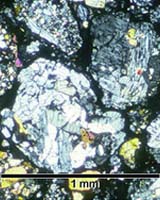
The recent crash of NASA's Genesis space probe may have looked like bad news for scientists, but its cargo of particles captured from the sun should still yield useful information, according to Qing-Zhu Yin, a planetary scientist at UC Davis. Yin, who is not directly affiliated with the Genesis mission, studies the composition of meteorites to learn about the formation of the solar system. Like the Genesis capsule, meteorites have a hard landing on the Earth, but can still yield useful information, he said. By looking at the ratio of oxygen-16, -17 and -18 isotopes in the solar particles, scientists should be able to test theories about how the sun and planets formed. Oxygen-16 is by far the most common. The Earth, moon, Mars and some meteorites all have slightly different ratios of the three isotopes. The oxygen makeup of the sun, which contains about 99.9 percent of all the mass in the solar system, is much harder to measure. The Genesis spacecraft was built to answer that question by collecting particles blown out from the sun. In a "Perspectives" article in the Sept. 17 issue of the journal Science, Yin describes new theories about local variations in oxygen isotopes in the vast dust and gas cloud around the young sun. Free oxygen was released when ultraviolet light hit carbon monoxide gas. Because oxygen-16 was so abundant, it was released mostly near the surface of the cloud, but breakdown of carbon monoxide containing less abundant oxygen-17 or -18 continued deeper into the cloud. Free oxygen and hydrogen formed water that froze onto dust grains and eventually formed into planets, preserving the oxygen-17 and -18 signature, Yin said. The models predict that the Sun itself should have a much lower ratio of oxygen-17 and -18 to oxygen-16 than the rocky planets, a prediction that can be tested by Genesis and future missions. Related Links UC Davis SpaceDaily Search SpaceDaily Subscribe To SpaceDaily Express  Genesis Board Turn Over Surviving Science Package To Scientists
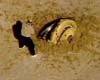 Dugway (SPX) Sep 21, 2004
The NASA Genesis Mishap Investigation Board (MIB) arrived at Dugway Proving Ground (DPG), Utah, September 10, to take charge of the investigation. The Genesis Sample Return Capsule (SRC) impacted the ground after its drogue and parafoil systems failed to deploy during re-entry September 8. Dr. Michael Ryschkewitsch is the leader of the MIB.
|
|
| |||||||||
| The content herein, unless otherwise known to be public domain, are Copyright 1995-2016 - Space Media Network. All websites are published in Australia and are solely subject to Australian law and governed by Fair Use principals for news reporting and research purposes. AFP, UPI and IANS news wire stories are copyright Agence France-Presse, United Press International and Indo-Asia News Service. ESA news reports are copyright European Space Agency. All NASA sourced material is public domain. Additional copyrights may apply in whole or part to other bona fide parties. Advertising does not imply endorsement, agreement or approval of any opinions, statements or information provided by Space Media Network on any Web page published or hosted by Space Media Network. Privacy Statement All images and articles appearing on Space Media Network have been edited or digitally altered in some way. Any requests to remove copyright material will be acted upon in a timely and appropriate manner. Any attempt to extort money from Space Media Network will be ignored and reported to Australian Law Enforcement Agencies as a potential case of financial fraud involving the use of a telephonic carriage device or postal service. |