|
 |
 |
 |
 |
 |
 |
 |
 |
 |

| . |  |
. |
Blast Affected Earth From Halfway Across The Milky Way
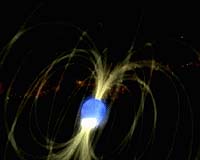
Forget "Independence Day" or "War of the Worlds." A monstrous cosmic explosion last December showed that the earth is in more danger from real-life space threats than from hypothetical alien invasions. The gamma-ray flare, which briefly outshone the full moon, occurred within the Milky Way galaxy. Even at a distance of 50,000 light-years, the flare disrupted the earth's ionosphere. If such a blast happened within 10 light-years of the earth, it would destroy the much of the ozone layer, causing extinctions due to increased radiation. "Astronomically speaking, this explosion happened in our backyard. If it were in our living room, we'd be in big trouble!" Said Bryan Gaensler (Harvard-Smithsonian Center for Astrophysics), lead author on a paper describing radio observations of the event. Gaensler headed one of two teams reporting on this eruption at a special press event today at NASA headquarters. A multitude of papers are planned for publication. The giant flare detected on December 27, 2004, came from an isolated, exotic neutron star within the Milky Way. The flare was more powerful than any blast previously seen in our galaxy. "This might be a once-in-a-lifetime event for astronomers, as well as for a neutron star," said David Palmer of Los Alamos National Laboratory, lead author on a paper describing space-based observations of the burst. "We know of only two other giant flares in the past 35 years, and this December event was one hundred times more powerful." NASA's newly launched Swift satellite and the NSF-funded Very Large Array (VLA) were two of many observatories that observed the event, arising from neutron star SGR 1806-20, about 50,000 light years from Earth in the constellation Sagittarius. Neutron stars form from collapsed stars. They are dense, fast-spinning, highly magnetic, and only about 15 miles in diameter. SGR 1806-20 is a unique neutron star called a magnetar, with an ultra-strong magnetic field capable of stripping information from a credit card at a distance halfway to the Moon. Only about 10 magnetars are known among the many neutrons stars in the Milky Way. "Fortunately, there are no magnetars anywhere near the earth. An explosion like this within a few trillion miles could really ruin our day," said graduate student Yosi Gelfand (CfA), a co-author on one of the papers. The magnetar's powerful magnetic field generated the gamma-ray flare in a violent process known as magnetic reconnection, which releases huge amounts of energy. The same process on a much smaller scale creates solar flares. "This eruption was a super-super-super solar flare in terms of energy released," said Gaensler. Using the VLA and three other radio telescopes, Gaensler and his team detected material ejected by the blast at a velocity three-tenths the speed of light. The extreme speed, combined with the close-up view, yielded changes in a matter of days. Spotting such a nearby gamma-ray flare offered scientists an incredible advantage, allowing them to study it in more detail than ever before. "We can see the structure of the flare's aftermath, and we can watch it change from day to day. That combination is completely unprecedented," said Gaensler. Headquartered in Cambridge, Mass., the Harvard-Smithsonian Center for Astrophysics (CfA) is a joint collaboration between the Smithsonian Astrophysical Observatory and the Harvard College Observatory. CfA scientists, organized into six research divisions, study the origin, evolution and ultimate fate of the universe. Related Links SpaceDaily Search SpaceDaily Subscribe To SpaceDaily Express  Swift Mission Images The Birth Of A Black Hole
 Washington DC (SPX) Jan 27, 2005
The NASA-led Swift mission has detected and imaged its first gamma-ray burst, likely the birth cry of a brand new black hole. The bright and long burst occurred on January 17. It was in the midst of exploding, as Swift autonomously turned to focus in less than 200 seconds.
|
|
| |||||||||
| The content herein, unless otherwise known to be public domain, are Copyright 1995-2016 - Space Media Network. All websites are published in Australia and are solely subject to Australian law and governed by Fair Use principals for news reporting and research purposes. AFP, UPI and IANS news wire stories are copyright Agence France-Presse, United Press International and Indo-Asia News Service. ESA news reports are copyright European Space Agency. All NASA sourced material is public domain. Additional copyrights may apply in whole or part to other bona fide parties. Advertising does not imply endorsement, agreement or approval of any opinions, statements or information provided by Space Media Network on any Web page published or hosted by Space Media Network. Privacy Statement All images and articles appearing on Space Media Network have been edited or digitally altered in some way. Any requests to remove copyright material will be acted upon in a timely and appropriate manner. Any attempt to extort money from Space Media Network will be ignored and reported to Australian Law Enforcement Agencies as a potential case of financial fraud involving the use of a telephonic carriage device or postal service. |