|
 |
 |
 |
 |
 |
 |
 |
 |
 |

| . |  |
. |
Intriguing Celestial Images Arrive From Galaxy Mission
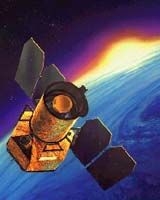
NASA's Galaxy Evolution Explorer has beamed back revealing images of hundreds of galaxies to expectant astronomers, providing the first batch of data on star formation that they had hoped for. "The images clearly show active star formation in nearby galaxies, and large numbers of distant ultraviolet galaxies undergoing starbursts," said Dr. Christopher Martin, the mission's principal investigator and an astrophysics professor at the California Institute of Technology in Pasadena, which leads the mission. "This demonstrates that the Galaxy Evolution Explorer will be a powerful tool for studying star formation in galaxies near and far." "These stunning images provide us with valuable information needed to advance our knowledge of how galaxies, like our own Milky Way, evolve and transform," said Dr. James Fanson, Galaxy Evolution Explorer project manager at NASA's Jet Propulsion Laboratory, Pasadena, Calif. "Pictures of the ultraviolet sky reveal objects we could never have seen with visible light alone." The Galaxy Evolution Explorer launched on April 28, 2003. Its goal is to map the celestial sky in the ultraviolet and determine the history of star formation in the universe over the last 10 billion years. From its orbit high above Earth, the spacecraft will sweep the skies for up to 28 months using state-of-the-art ultraviolet detectors. Looking in the ultraviolet singles out galaxies dominated by young, hot, short-lived stars that give off a great deal energy at that wavelength. These galaxies are actively creating stars, therefore providing a window into the history and causes of galactic star formation. In addition to leading the mission, Caltech is also responsible for science operations and data analysis. NASA's Jet Propulsion Laboratory, Pasadena, Calif., a division of Caltech, manages the mission and led the science instrument development. The mission is part of NASA's Explorers Program, managed by the Goddard Space Flight Center, Greenbelt, Md. The mission's international partners are France and South Korea. Related Links Galaxy Evolution Explorer at Caltech SpaceDaily Search SpaceDaily Subscribe To SpaceDaily Express  GALEX Unfurls Deep Time Mission
 Pasadena - May 07, 2003
NASA's Galaxy Evolution Explorer successfully opened its telescope cover Tuesday at 4:32 am EDT. The cover deployment sequence involved the heating of a thermal actuator, which melted a wax pellet. When the wax melted, it pushed a mechanical pin, which in turn released the cover.
|
|
| |||||||||
| The content herein, unless otherwise known to be public domain, are Copyright 1995-2016 - Space Media Network. All websites are published in Australia and are solely subject to Australian law and governed by Fair Use principals for news reporting and research purposes. AFP, UPI and IANS news wire stories are copyright Agence France-Presse, United Press International and Indo-Asia News Service. ESA news reports are copyright European Space Agency. All NASA sourced material is public domain. Additional copyrights may apply in whole or part to other bona fide parties. Advertising does not imply endorsement, agreement or approval of any opinions, statements or information provided by Space Media Network on any Web page published or hosted by Space Media Network. Privacy Statement All images and articles appearing on Space Media Network have been edited or digitally altered in some way. Any requests to remove copyright material will be acted upon in a timely and appropriate manner. Any attempt to extort money from Space Media Network will be ignored and reported to Australian Law Enforcement Agencies as a potential case of financial fraud involving the use of a telephonic carriage device or postal service. |