|
 |
 |
 |
 |
 |
 |
 |
 |
 |

| . |  |
. |
Suns Of All Ages Possess Comets, Maybe Planets
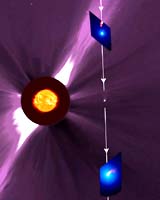
In early 2003, Comet Kudo-Fujikawa (C/2002 X5) zipped past the Sun at a distance half that of Mercury's orbit. Astronomers Matthew Povich and John Raymond (Harvard-Smithsonian Center for Astrophysics) and colleagues studied Kudo-Fujikawa during its close passage. Today at the 203rd meeting of the American Astronomical Society in Atlanta, they announced that they observed the comet puffing out huge amounts of carbon, one of the key elements for life. The comet also emitted large amounts of water vapor as the Sun's heat baked its outer surface. When combined with previous observations suggesting the presence of evaporating comets near young stars like Beta Pictoris and old stars like CW Leonis, these data show that stars of all ages vaporize comets that swing too close. Those observations also show that planetary systems like our own, complete with a collection of comets, likely are common throughout space. "Now we can draw parallels between a comet close to home and cometary activity surrounding the star Beta Pictoris, which just might have newborn planets orbiting it. If comets are not unique to our Sun, then might not the same be true for Earth-like planets?" Says Povich.
SOHO Sees Carbon UVCS can only study a small slice of the sky at one time. By holding the spectrograph slit steady and allowing the comet to drift past, the team was able to assemble the slices into a full, two-dimensional picture of the comet. The UVCS data revealed a dramatic tail of carbon ions streaming away from the comet, generated by evaporating dust. The instrument also captured a spectacular 'disconnection event,' in which a piece of the ion tail broke off and drifted away from the comet. Such events are relatively common, occurring when the comet passes through a region of space where the Sun's magnetic field switches direction.
Cometary Building Blocks "That's a massive amount of carbon, weighing as much as five supertankers," says Raymond. Povich adds, "Now, consider that astronomers see evidence for comets like this around newly formed stars like Beta Pictoris. If such stars have comets, then perhaps they have planets, too. And if extrasolar comets are similar to comets in our solar system, then the building blocks for life may be quite common."
Understanding Our Origins "Taken together, the observations of comets around young stars like Beta Pictoris, middle-aged stars like our Sun, and old stars like CW Leonis strengthen the connection between our solar system and extrasolar planetary systems. By studying our own neighborhood, we hope to learn not only about our origins, but about what we might find out there orbiting other stars," says Raymond. Other co-authors on the Science paper reporting these findings are Geraint Jones (JPL), Michael Uzzo and Yuan-Kuen Ko (CfA), Paul Feldman (Johns Hopkins), Peter Smith and Brian Marsden (CfA), and Thomas Woods (University of Colorado). Related Links Harvard-Smithsonian Center for Astrophysics SpaceDaily Search SpaceDaily Subscribe To SpaceDaily Express  Planetary Survivor Strategy: Outeat, "Outweigh," Outlast!
 Boston - Dec 30, 2003
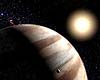
Of the first 100 stars found to harbor planets, more than 30 stars host a Jupiter-sized world in an orbit smaller than Mercury's, whizzing around its star in a matter of days (as opposed to our solar system where Jupiter takes 12 years to orbit the Sun). Such close orbits result from a race between a nascent gas giant and a newborn star.
|
|
| |||||||||
| The content herein, unless otherwise known to be public domain, are Copyright 1995-2016 - Space Media Network. All websites are published in Australia and are solely subject to Australian law and governed by Fair Use principals for news reporting and research purposes. AFP, UPI and IANS news wire stories are copyright Agence France-Presse, United Press International and Indo-Asia News Service. ESA news reports are copyright European Space Agency. All NASA sourced material is public domain. Additional copyrights may apply in whole or part to other bona fide parties. Advertising does not imply endorsement, agreement or approval of any opinions, statements or information provided by Space Media Network on any Web page published or hosted by Space Media Network. Privacy Statement All images and articles appearing on Space Media Network have been edited or digitally altered in some way. Any requests to remove copyright material will be acted upon in a timely and appropriate manner. Any attempt to extort money from Space Media Network will be ignored and reported to Australian Law Enforcement Agencies as a potential case of financial fraud involving the use of a telephonic carriage device or postal service. |