|
 |
 |
 |
 |
 |
 |
 |
 |
 |

| . |  |
. |
Benefits Of Space For All Citizens
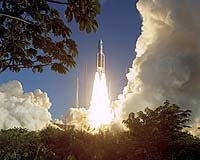
Over 40 nations and around 20 international organisations, including ESA, came together in Brussels, last Thursday and Friday, to exchange views on policies related to international cooperation in space. Entitled 'Winning through cooperation: sharing the benefits of space', the conference provided a forum for discussion between States capable of providing space technology � the supply side � and those willing to make use of it � the demand side. The conference was jointly organised by the European Commission and ESA in response to a perceived need to set up a platform for dialogue between the two sides. The conference was also attended by a strong contingent of representatives of the European space industry, which has become a key player on worldwide commercial markets in satellite manufacture, launch services and satellite operations. Attending the conference, ESA Director General Jean-Jacques Dordain stated: "The successful launch of Ariane 5 a few days ago (Saturday 12 February) brought us 'back to the future', boosting Europe's guaranteed access to space. And this outstanding achievement comes only a month after the discovery of a new world through the spectacular descent of ESA's science probe Huygens onto Titan. These are just two concrete examples of international cooperation: Ariane shows what several European states have been able to accomplish together in 30 years of cooperation within ESA, while Huygens - reaching Titan after a 7-year journey on board NASA's Cassini mothership - can be listed among the flagships of the longstanding ESA/NASA cooperation, which also extends to many more spacefaring countries". "Since 1975, the year of its foundation, ESA has been developing international cooperation, first within Europe and then beyond the boundaries of Europe. The US, Canada, Russia, Japan, China, India and most spacefaring countries are our partners, and we are ready to do more with our institutional partners worldwide and European space industry to further explore our Universe, and to better serve the needs of each citizen of the world in Earth Observation, Security, Telecommunications, Satellite Navigation, Meteorology and Space Science", added Dordain. In recent years ESA has been cooperating increasingly with a new partner, the European Union, through the European Commission. ESA, an independent European agency, is not part of the EU. Some countries that belong to the EU are not members of ESA and vice versa. There are, however, close ties between the two organisations and they share a common aim: to strengthen Europe and benefit its citizens. Although ESA has had ties with the EU since the EU was formed, these have grown in recent years because of the increasing role of space in strengthening Europe's political and economic role. Recent joint initiatives include the European global navigation system Galileo and the Global Monitoring for Environment and Security suite of services, known as GMES. An upcoming initiative concerns satellite-based measures to overcome the digital divide within Europe. The Commission has been involved in space for many years through its research programmes, but its role has recently been reinforced. Responsibility for space policy and space applications has been transferred from the Research Directorate-General to that for Enterprise and Industry, under the responsibility of Vice-President G�nter Verheugen. "The Commission is currently working on a proposal for a genuine European Space Policy. Reaching for the stars brings very down to earth benefits to our citizens and industry, from radio navigation, communication by satellite or early warning of natural disasters. "We need to step up cooperation, on an EU scale level and internationally. Nobody can go it alone. The Commission also wants to substantially increase R&D efforts for space under the new R&D Framework Programme and we are assessing how to combine this with investment in appropriate public-private partnerships" said Vice-President Verheugen, Commissioner for Enterprise and Industry, in charge of competitiveness and space matters. Related Links EC GMES site GMES Services Element International Charter on Space and Major Disasters SpaceDaily Search SpaceDaily Subscribe To SpaceDaily Express  Russia And Europe Sign Space Agreement
 Moscow (AFP) Jan 19, 2005
Russia and the European Space Agency (ESA) signed an agreement Wednesday allowing Russia to use ESA's sites for space launches and allowing the two sides to freely exchange research and development information.
|
|
| |||||||||
| The content herein, unless otherwise known to be public domain, are Copyright 1995-2016 - Space Media Network. All websites are published in Australia and are solely subject to Australian law and governed by Fair Use principals for news reporting and research purposes. AFP, UPI and IANS news wire stories are copyright Agence France-Presse, United Press International and Indo-Asia News Service. ESA news reports are copyright European Space Agency. All NASA sourced material is public domain. Additional copyrights may apply in whole or part to other bona fide parties. Advertising does not imply endorsement, agreement or approval of any opinions, statements or information provided by Space Media Network on any Web page published or hosted by Space Media Network. Privacy Statement All images and articles appearing on Space Media Network have been edited or digitally altered in some way. Any requests to remove copyright material will be acted upon in a timely and appropriate manner. Any attempt to extort money from Space Media Network will be ignored and reported to Australian Law Enforcement Agencies as a potential case of financial fraud involving the use of a telephonic carriage device or postal service. |