


|
Free Newsletters - Space News - Defense Alert - Environment Report - Energy Monitor |
|
|
|
|
|
|
|
|
|


| . |  |
. |
|
|
|
Chinese Professor Develops New Magnetic Train
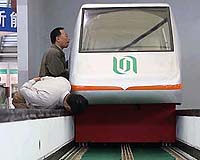
A Shanghai physics professor says he has the technology for the first magnetic train fully developed in China. Wei Lehan, 66, a professor at Shanghai Normal University, says the Magnetic Array Suspension (MAS) system he developed is the first in the nation with independent intellectual property rights. A sample train, on show at the Sixth Shanghai International Industry Fair, attracted many professional visitors Thursday. The train's technology is different from models used in Germany and Japan.The MAS train is powered by a combination of attraction and repulsion generated from permanent magnets both on the train and the tracks. Building an MAS system, he said, would cost about 30 million yuan (US$3.6 million) per kilometre, about one-10th what the German technology would cost. It would also save considerable amounts of land and energy. "I am sure of the future success of this revolutionary technology, though there are many other non-technological obstacles," said Wei, driving visitors back and forth on his model. Compared with the luxury maglev train running in Pudong from Longyang Station to Pudong International Airport, the train Wei has built with the help of two workers in five months looked shabby. It was poorly decorated and the control board was very simple. The sample, 3.75 metres long and 1.4 metres wide, sits six people inside a silver and white train car. When the train, powered by three batteries used for ordinary electric bikes, moves on the 11-metre-long tracks, it emits an uneasy noise. "The tracks had to be cut into halves before being moved from the school here and the connection is not so smooth," Wei explained. Said by Wei to "shame all other maglev experts in the world if successful," the technology was authenticated by the Shanghai Municipal Education Commission in late October. "It is improper to point out all the shortcomings of his work, but science is a serious thing and the development of a new technology usually takes a long time and a lot of tests," said Wu Xiangming, chief engineer of the Pudong maglev. Though Wei hopes his technology will be commercialized soon, there have only been inquiries to date, with no specific investments in sight. Related Links SpaceDaily Search SpaceDaily Subscribe To SpaceDaily Express  Research on "Holes" May Unearth Causes of Superconductivity
 Upton NY (SPX) Oct 28, 2004
Scientists at the U.S. Department of Energy�s Brookhaven National Laboratory have uncovered another possible clue to the causes of high-temperature superconductivity, a phenomenon in which the electrical resistance of a material disappears below a certain temperature. In a superconducting compound, they found evidence of a rarely seen arrangement of "holes" � locations where electrons are absent. The results appear in the October 28, 2004, issue of Nature.
|
 |
| |||||||||
| The content herein, unless otherwise known to be public domain, are Copyright 1995-2016 - Space Media Network. All websites are published in Australia and are solely subject to Australian law and governed by Fair Use principals for news reporting and research purposes. AFP, UPI and IANS news wire stories are copyright Agence France-Presse, United Press International and Indo-Asia News Service. ESA news reports are copyright European Space Agency. All NASA sourced material is public domain. Additional copyrights may apply in whole or part to other bona fide parties. Advertising does not imply endorsement, agreement or approval of any opinions, statements or information provided by Space Media Network on any Web page published or hosted by Space Media Network. Privacy Statement All images and articles appearing on Space Media Network have been edited or digitally altered in some way. Any requests to remove copyright material will be acted upon in a timely and appropriate manner. Any attempt to extort money from Space Media Network will be ignored and reported to Australian Law Enforcement Agencies as a potential case of financial fraud involving the use of a telephonic carriage device or postal service. |