|
 |
 |
 |
 |
 |
 |
 |
 |
 |

| . |  |
. |
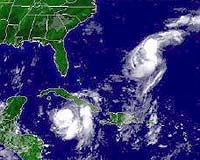
Better Wind, Damage Models Would Help Insurers Anticipate Hurricane Costs
Orlando FL (SPX) Oct 21, 2004 Insurance companies could better anticipate their annual costs in hurricane claims if they used more accurate models of storm winds and the severity of damage they will likely cause, a University of Central Florida professor and his Georgia colleague concluded. UCF statistics professor Mark Johnson and Chuck Watson, founder of Kinetic Analysis Corp. of Savannah, Ga., analyzed 324 combinations of public and private models that insurance companies use to predict wind speeds and damage and estimate storm losses. In an article written for the November issue of the Bulletin of the American Meteorological Society, Johnson and Watson concluded that the models produce vastly different results, leaving a lot of uncertainty in how much risk insurance companies face each year and how much they should charge policyholders. The models reviewed by Johnson and Watson do not forecast the paths of particular storms. They simulate the damage caused by storms based on storm tracks, which usually are provided by the National Hurricane Center. To develop projections for insurance companies' losses, the models consider data such as historical storm tracks, the percentages of concrete, wood-frame and mobile homes in an area and projected wind speeds. The researchers suggested that creating a centralized database of wind speeds during storms and requiring insurance companies to divulge more information about the reports of damage they receive and the claims they pay would help to make the models more accurate. The insurance company models also did not consider some factors, such as soil moisture and the possibility of leftover debris from prior hurricanes, which can dramatically influence how much damage storms inflict. Before Hurricane Andrew struck South Florida in 1992, insurance companies generally relied on analyses of their losses during prior years to set premiums and deductibles. The catastrophic damage caused by Hurricane Andrew prompted insurance companies to base decisions on models that predict wind speed, how winds may be slowed by structures or different terrains and the estimated damage those winds would cause. Many of the models used by companies are private and therefore could not be directly reviewed by Johnson and Watson. However, the publicly available models and data provided by private modelers to a Florida commission showed dramatic differences in estimates of wind speeds and damage, especially for inland areas. "This range (in the models' results) presents a major problem for regulators, government officials and consumers, as the choice of model could result in premiums differing by several hundred dollars a year for a typical home," the researchers wrote in the Bulletin of the American Meteorological Society article. In response to residents' concerns about hurricane premiums and deductibles, Florida legislators likely will consider changes to some of the state's policies regarding hurricane insurance. Legislators do not set insurance rates, but they can pass laws regulating them. Johnson and Watson do not recommend any specific legislation regarding how states regulate insurance rates. However, they said they can help legislators assess how changes to premium or deductible structures would affect homeowners and insurance companies. "Those tests are essential when you're dealing with insurance, because you're experimenting with people's lives and the economic livelihood of insurance companies," Watson said. The two researchers run a Web site that includes storm tracks and projected damage estimates for approaching storms. The damage estimates are based on a more comprehensive database of properties than what insurance company models typically use. Johnson and Watson are consultants to the Florida Commission on Hurricane Loss Projection Methodology, which reviews and accepts public and private hurricane models. The analyses that will be reported in the Bulletin of the American Meteorological Society were funded by the states of North Carolina and Florida, the Organization of American States and the U.S. Agency for International Development. Data from Florida was used in that study, and the general conclusions are applicable throughout the United States. Related Links SpaceDaily Search SpaceDaily Subscribe To SpaceDaily Express  Green And Greener: Nobel Prize Highlights Rise Of Environmentalism
 Paris, France (AFP) Oct 08, 2004
The awarding of the 2004 Nobel Peace Prize to African ecologist Wangari Maathai reflects environmentalism's extraordinary rise from the wings to the centre stage of politics in less than three decades.
|
|
| |||||||||
| The content herein, unless otherwise known to be public domain, are Copyright 1995-2016 - Space Media Network. All websites are published in Australia and are solely subject to Australian law and governed by Fair Use principals for news reporting and research purposes. AFP, UPI and IANS news wire stories are copyright Agence France-Presse, United Press International and Indo-Asia News Service. ESA news reports are copyright European Space Agency. All NASA sourced material is public domain. Additional copyrights may apply in whole or part to other bona fide parties. Advertising does not imply endorsement, agreement or approval of any opinions, statements or information provided by Space Media Network on any Web page published or hosted by Space Media Network. Privacy Statement All images and articles appearing on Space Media Network have been edited or digitally altered in some way. Any requests to remove copyright material will be acted upon in a timely and appropriate manner. Any attempt to extort money from Space Media Network will be ignored and reported to Australian Law Enforcement Agencies as a potential case of financial fraud involving the use of a telephonic carriage device or postal service. |