|
 |
 |
 |
 |
 |
 |
 |
 |
 |

| . |  |
. |
Unexpected Discovery About Core
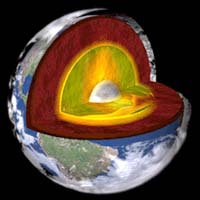
The core of the earth doesn't look the way it was expected to. Scientists at the Royal Institute of Technology in Stockholm, Sweden, KTH, can now show that iron, under extremely high pressure, such as that found in the inner earth, takes on unexpected properties, and this can be of importance in understanding the movements of the earth, such as, earthquakes. The results are being presented in the new issue of the British scientific journal Nature. The core of the earth consists almost exclusively of iron. The iron atoms in a piece of iron, in room temperature, are packed according to a certain structure, in this case called body centered cubic or bcc. This means the atoms are relatively sparsely packed. When the piece of iron is exposed to greater pressure, the iron atoms place themselves differently in relation to each other and take on another kind of structure, so-called hexagonal close packed, or hcp. The become more densely packed, which seems natural, and it has long been assumed that the higher the temperature and pressure iron is exposed to, the more stable the hpc structure will be. Researchers from the department KTH Materials Science maintain, however, that this not the case. With the help of computer simulations, they have now shown that iron, unexpectedly, reverts to bcc structure at extreme temperatures and pressures. Exactly why this occurs is the next question for science to tackle. Research into the inner parts of the earth has enjoyed a great boom over the last few years, largely owing to the fact that equipment has not been available until today to simulate the conditions down there. It is pure research, and the discoveries are thus far difficult to evaluate in terms of money or practical applications, but it might be possible to use increased knowledge of the construction of the earth in geology to understand the significance of the core of the earth in earthquakes or volcano eruptions. Related Links Swedish Research Council Stockholm SpaceDaily Search SpaceDaily Subscribe To SpaceDaily Express  Cropslands Push Up Average Tropical Temperatures
 Greenbelt - Aug 26, 2003
While croplands may provide more food than forests, they don�t offer much relief from hot tropical climes, a new study finds.
|
|
| |||||||||
| The content herein, unless otherwise known to be public domain, are Copyright 1995-2016 - Space Media Network. All websites are published in Australia and are solely subject to Australian law and governed by Fair Use principals for news reporting and research purposes. AFP, UPI and IANS news wire stories are copyright Agence France-Presse, United Press International and Indo-Asia News Service. ESA news reports are copyright European Space Agency. All NASA sourced material is public domain. Additional copyrights may apply in whole or part to other bona fide parties. Advertising does not imply endorsement, agreement or approval of any opinions, statements or information provided by Space Media Network on any Web page published or hosted by Space Media Network. Privacy Statement All images and articles appearing on Space Media Network have been edited or digitally altered in some way. Any requests to remove copyright material will be acted upon in a timely and appropriate manner. Any attempt to extort money from Space Media Network will be ignored and reported to Australian Law Enforcement Agencies as a potential case of financial fraud involving the use of a telephonic carriage device or postal service. |