|
 |
 |
 |
 |
 |
 |
 |
 |
 |

| . |  |
. |
Narrow Wind Cause Huge Ocean Impact, Says Physicist
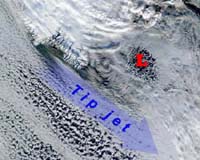
Toronto - Aug 11, 2003 A narrow but intense wind may be the mechanism responsible for the existence of a newly discovered ocean convection site east of Greenland, says a University of Toronto scientist. In earlier research, oceanographers discovered that deep water in the Irminger Sea (east of Greenland) was of similar temperature and salinity to that in the Labrador Sea. The latter is one of only two areas where deep ocean water is traditionally thought to form in the North Atlantic through convection (a process whereby surface water loses heat and moisture, becomes dense, sinks to the bottom and flows towards the equator). Given the distance involved between the Labrador and Irminger Seas and the time frame studied, the oceanographers knew the water could not have flowed from one site to the other. They asked Professor Kent Moore of U of T's physics department for an explanation. He believes the Irminger Sea has its own convection process triggered by an intense atmospheric jet of very strong winds called the Greenland tip jet. With wind speeds that reach 30 metres per second, the tip jet cools the surface water and makes it more saline, thereby prompting the convection cycle. "The interesting thing is not just that we have increased the number of convection sites in the North Atlantic from two to three, which is contrary to previous oceanographic understanding," Moore says. "It is also that these very small tip jets in the atmosphere -- only about 100 kilometres wide -- can have such a huge impact on the entire ocean, which in turn regulates the Atlantic climatic system." The research findings are published in the article "Deep Convection in the Irminger Sea Forced by the Greenland Tip Jet" in the July 10 issue of Nature. Funding support was supplied by the National Science Foundation, Ocean Sciences Division. Lanna Crucefix is an assistant news services officer with the department of public affairs at the University of Toronto Related Links U of T Dept. of Physics SpaceDaily Search SpaceDaily Subscribe To SpaceDaily Express  UCAR Foundation To Launch Technology Transfer Company
 Boulder - Jul 29, 2003
A new company to guide atmospheric research from the laboratory to the commercial market will open for business in August. Located in Boulder, Peak Weather Resources Inc. will rely on initial seed funding from the UCAR Foundation but will operate independently from it.
|
|
| |||||||||
| The content herein, unless otherwise known to be public domain, are Copyright 1995-2016 - Space Media Network. All websites are published in Australia and are solely subject to Australian law and governed by Fair Use principals for news reporting and research purposes. AFP, UPI and IANS news wire stories are copyright Agence France-Presse, United Press International and Indo-Asia News Service. ESA news reports are copyright European Space Agency. All NASA sourced material is public domain. Additional copyrights may apply in whole or part to other bona fide parties. Advertising does not imply endorsement, agreement or approval of any opinions, statements or information provided by Space Media Network on any Web page published or hosted by Space Media Network. Privacy Statement All images and articles appearing on Space Media Network have been edited or digitally altered in some way. Any requests to remove copyright material will be acted upon in a timely and appropriate manner. Any attempt to extort money from Space Media Network will be ignored and reported to Australian Law Enforcement Agencies as a potential case of financial fraud involving the use of a telephonic carriage device or postal service. |