|
 |
 |
 |
 |
 |
 |
 |
 |
 |

| . |  |
. |
Asteroids Rained Down During Final Formation Of Earth
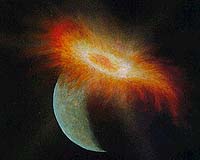
Tucson - Mar 4, 2002 The bombardment that resurfaced the Earth 3.9 billion years ago was produced by asteroids, not comets, according to David Kring of the University of Arizona Lunar & Planetary Laboratory and Barbara Cohen, formerly at the UA and now with the University of Hawaii. Their findings appeared in the Thursday, Feb. 28 edition of the Journal of Geophysical Research published by the American Geophysical Union. The significance of this conclusion is that the bombardment was so severe that it destroyed older rocks on Earth. Which, Kring says, is the reason why the oldest rocks found are less than 3.9 billion years old. Additionally, they argue, impact-generated hydrothermal systems would have been excellent incubators for pre-biotic chemistry and the early evolution of life, consistent with previous work that shows life originated in hot water systems around or slightly before 3.85 billion years ago. This same bombardment according to Kring and Cohen, affected the entire inner solar system, producing thousands of impact craters on Mercury, Venus, the Moon and Mars. Most of the craters in the southern hemisphere of Mars were produced during this event.
Several impact craters of about 5,000 kilometers were created as well-each one exceeding the dimensions of Australia, Europe, Antarctica or South America. The thousands of impacts occurred in a very short period of time, potentially producing a globally-significant environmental change at an average rate of once per 100 years. Also, the event is recorded in the asteroid belt, as witnessed by the meteoritic fragments which have survived to fall to Earth today. Kring, has been involved in the research and measurements of the Chicxulub impact crater located near Merida, Yucatan, Mexico. He has collaborated on and led various international research teams which have drilled to unearth evidence of the Cretaceous-Tertiary (K/T) impact which is thought to have led to mass extinctions on Earth, including dinosaur extinction. Earlier this month, Kring returned from a drilling operation at the impact site where crews worked around the clock to recover core samples to determine what the impactor was and details of the catastrophic event that wiped out more than 75 percent of all plant and animal species on Earth. Lunar and Planetary Laboratory An off beat spaceguard link SpaceDaily Search SpaceDaily Subscribe To SpaceDaily Express  How Early Did Earth Get Wet
 Paris (ESA) Jan 21, 2002
Planet-like bodies with liquid water formed very early in the history of the Solar System, or so scientists used to think. That scenario may now be due for revision after a finding with ESA's Infrared Space Observatory, ISO.
|
|
| ||||||||||
| The content herein, unless otherwise known to be public domain, are Copyright 1995-2016 - Space Media Network. All websites are published in Australia and are solely subject to Australian law and governed by Fair Use principals for news reporting and research purposes. AFP, UPI and IANS news wire stories are copyright Agence France-Presse, United Press International and Indo-Asia News Service. ESA news reports are copyright European Space Agency. All NASA sourced material is public domain. Additional copyrights may apply in whole or part to other bona fide parties. Advertising does not imply endorsement, agreement or approval of any opinions, statements or information provided by Space Media Network on any Web page published or hosted by Space Media Network. Privacy Statement All images and articles appearing on Space Media Network have been edited or digitally altered in some way. Any requests to remove copyright material will be acted upon in a timely and appropriate manner. Any attempt to extort money from Space Media Network will be ignored and reported to Australian Law Enforcement Agencies as a potential case of financial fraud involving the use of a telephonic carriage device or postal service. |