|
 |
 |
 |
 |
 |
 |
 |
 |
 |

| . |  |
. |
Space Launch Scraps Providing Sustenance For Russian Villagers
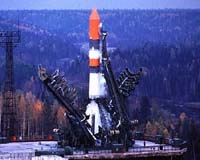
Since the Plesetsk Space Center began operations in northern Russia forty years ago, tons of man-made debris - first stages of rockets mainly - have fallen to earth, generating both a cash opportunity for local villagers, and a source of danger, RIA Novosti recently reported. Some villages survive only on this cosmic garbage, unable to find other ways to make ends meet. The neighboring space center outlines the regions that have the highest risk of being exposed to space debris several days before every launch. Hunters, mushroom pickers, fishermen and reindeer breeders are all emphatically warned of the dangers of being in the area. They do leave, but afterwards scores of local residents, some equipped with tractors, get into the area to reap little-damaged Soyuz first stages. Soyuz carrier rockets are propelled by kerosene and oxygen, and their parts have a reputation for safety. Older Tsiklon and Rokot carriers propelled by poisonous heptyl leave scraps that people avoid for a few years, until "self-cleaning" (as locals have coined the process) makes it safe for people to extract the metals. Scrap metal collectors generally will not comment on how much they collect in a year but fragmented data for 2003 alone indicated that about 20 tons of "space metals" was collected. Lesser-damaged parts are used in households: electric batteries are connected to lamps, metal sheets made of stainless alloys are used to build basements, garages, fences, water tracks and long, slim boats, much like canoes. The Northern Medical University has studied the effect of liquid propellant components on human health - particularly where heptyl was used - and have warned that the death rate in mentioned affected areas has risen by 30%, mostly due to liver, blood and genetic diseases. However, it has so far failed to draw a direct link from the launches to the deaths. Experts say additional studies are necessary to come to any definite conclusions. Related Links SpaceDaily Search SpaceDaily Subscribe To SpaceDaily Express  Space Debris Mitigation: The Case For A Code Of Conduct
 Darmstadt, Germany (ESA) Apr 18, 2005
There is a lot of junk orbiting the Earth and the problem will worsen unless there are changes in how spacecraft operators operate. But it is not all doom and gloom.
|
|
| |||||||||
| The content herein, unless otherwise known to be public domain, are Copyright 1995-2016 - Space Media Network. All websites are published in Australia and are solely subject to Australian law and governed by Fair Use principals for news reporting and research purposes. AFP, UPI and IANS news wire stories are copyright Agence France-Presse, United Press International and Indo-Asia News Service. ESA news reports are copyright European Space Agency. All NASA sourced material is public domain. Additional copyrights may apply in whole or part to other bona fide parties. Advertising does not imply endorsement, agreement or approval of any opinions, statements or information provided by Space Media Network on any Web page published or hosted by Space Media Network. Privacy Statement All images and articles appearing on Space Media Network have been edited or digitally altered in some way. Any requests to remove copyright material will be acted upon in a timely and appropriate manner. Any attempt to extort money from Space Media Network will be ignored and reported to Australian Law Enforcement Agencies as a potential case of financial fraud involving the use of a telephonic carriage device or postal service. |