|
 |
 |
 |
 |
 |
 |
 |
 |
 |

| . |  |
. |
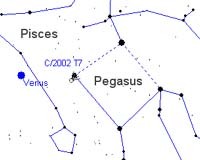
Comet Ahoy Off Venus
Comet C/2002 T7 is approaching Earth and brightening every day. It's not yet a naked-eye object, but the 7th-magnitude fuzzball is easy to see through backyard telescopes. The comet lies not far from brilliant Venus in the western sky after sunset. For the next three months, the comet will continue to brighten as it nears Earth. May 19th is the date of closest approach (0.27 AU). At that time C/2002 T7 might glow brighter than a 1st magnitude star--easily seen with the unaided eye. There remains considerable uncertainty about how bright this object will become. In May you'll have to be in the southern hemisphere to see it easily. Now is the best time for northern hemisphere observers to look, before the comet plunges south. Related Links More Pixs and Charts at Spaceweather.com SpaceDaily Search SpaceDaily Subscribe To SpaceDaily Express  UK Scientists All Set For New Year Encounter With A Comet
  London - Dec 17, 2003
On January 2nd 2004 the NASA space mission, Stardust, will fly through comet Wild 2, capturing interstellar particles and dust and returning them to Earth in 2006. Space scientists from the Open University and University of Kent have developed one of the instruments which will help tell us more about comets and the evolution of our own solar system and, critical for Stardust, its survival in the close fly-by of the comet.
|
|
| |||||||||
| The content herein, unless otherwise known to be public domain, are Copyright 1995-2016 - Space Media Network. All websites are published in Australia and are solely subject to Australian law and governed by Fair Use principals for news reporting and research purposes. AFP, UPI and IANS news wire stories are copyright Agence France-Presse, United Press International and Indo-Asia News Service. ESA news reports are copyright European Space Agency. All NASA sourced material is public domain. Additional copyrights may apply in whole or part to other bona fide parties. Advertising does not imply endorsement, agreement or approval of any opinions, statements or information provided by Space Media Network on any Web page published or hosted by Space Media Network. Privacy Statement All images and articles appearing on Space Media Network have been edited or digitally altered in some way. Any requests to remove copyright material will be acted upon in a timely and appropriate manner. Any attempt to extort money from Space Media Network will be ignored and reported to Australian Law Enforcement Agencies as a potential case of financial fraud involving the use of a telephonic carriage device or postal service. |