|
 |
 |
 |
 |
 |
 |
 |
 |
 |

| . |  |
. |
Ecosystem Changes In Polar Regions Linked To Solar Variability
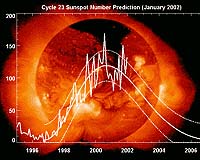
A Lawrence Livermore National Laboratory scientist, in collaboration with an international team of colleagues, has reported that noticeable changes in the sub-polar climate and ecosystems appear to be linked to variations in the sun's intensity during the past 12,000 years. The research, titled "Cyclic Variation and Solar Forcing of Holocene Climate in the Alaskan Subarctic," is reported in today's (Sept. 26) issue of Science. Using core sediment samples from Arolik Lake in the tundra region along the southwestern coast of Alaska, Thomas Brown of Livermore's Center for Accelerator Mass Spectrometry measured the amount of carbon-14 in samples to provide a chronological framework for the biological and organic evidence of climate and ecosystem changes, which occurred during the Holocene Epoch (12,000 years ago to present). By studying biological, geochemical and isotopic constituents of sediment samples (such as biogenic silica from single-celled algae, which reflects lake productivity), the researchers determined that variations of these components provided evidence of climate and ecosystem variations over the past 12,000 years. The scientists identified significant cycles lasting 200, 435, 590 and 950 years in the 12,000-year record, which are consistent with previously recognized cycles of solar activity. By comparison of the Alaskan subarctic record to recent findings of North Atlantic ice cover variations and solar-activity-modulated production records of beryllium- 10 and carbon-14, the scientists showed that the changes in sub-polar climate and ecosystems are correlated with records related to slight variations in solar irradiance. The data from biogenic silica, North Atlantic sea ice, and beryllium-10 and carbon-14 showed "remarkable correlation during the cycles", Brown said. "We found natural cycles involving climate and ecosystems that seem to be related to weak solar cycles, which, if verified, could be an important factor to help us understand potential future changes of Earth's climate," said principal investigator Feng Sheng Hu of the University of Illinois at Champaign- Urbana. "Will changes in solar irradiation in the future mitigate or exacerbate global warming in the future? They may do both. A period of high solar irradiance on top of high levels of greenhouse gases could result in unprecedented warming." Related Links Lawrence Livermore National Laboratory SpaceDaily Search SpaceDaily Subscribe To SpaceDaily Express  Undergrads Ready For Launch
 Wallops Island - Sep 10, 2003
After two years of planning and preparation, undergraduate students from the University of Virginia, Charlottesville, are ready for the launch of their experiments aboard a NASA rocket in the early morning on Sept 16.
|
|
| |||||||||
| The content herein, unless otherwise known to be public domain, are Copyright 1995-2016 - Space Media Network. All websites are published in Australia and are solely subject to Australian law and governed by Fair Use principals for news reporting and research purposes. AFP, UPI and IANS news wire stories are copyright Agence France-Presse, United Press International and Indo-Asia News Service. ESA news reports are copyright European Space Agency. All NASA sourced material is public domain. Additional copyrights may apply in whole or part to other bona fide parties. Advertising does not imply endorsement, agreement or approval of any opinions, statements or information provided by Space Media Network on any Web page published or hosted by Space Media Network. Privacy Statement All images and articles appearing on Space Media Network have been edited or digitally altered in some way. Any requests to remove copyright material will be acted upon in a timely and appropriate manner. Any attempt to extort money from Space Media Network will be ignored and reported to Australian Law Enforcement Agencies as a potential case of financial fraud involving the use of a telephonic carriage device or postal service. |