|
 |
 |
 |
 |
 |
 |
 |
 |
 |

| . |  |
. |
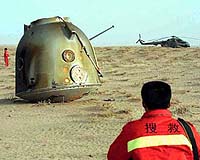
China's Shenzhou 3 Spacecraft Returns To Earth Safely
China's third unmanned space craft returned successfully to earth Monday after a week-long mission which marked another step in Beijing's plan to put an astronaut into orbit, state media said. The Shenzhou III (Divine Vessel III) space capsule returned to earth in central Inner Mongolia at 4:51 pm (08:51 GMT), the Xinhua news agency said. The mission, the third test flight of China's fledgling space program, took off from the Jiuquan launch center in northern Gansu province late on March 25, making it the longest flight in the series. The return of the re-entry module came after the spacecraft had orbited the earth 108 times. An orbiting section was expected to continue to circle the earth for "the coming months", the report said. China is aiming to become the third nation to put a human in space after the former Soviet Union and the United States. "The successful launch and return of Shenzhou III has laid a solid basis for the country's future endeavor to send man to outer space," Xinhua quoted leading space officials as saying. On-board life support systems made the capsule "technically suitable for astronauts", they said. With the success of Shenzhou III, China could launch its first manned space flight as early as next year, with two astronauts expected to be on board the inaugural trip, Chinese space officials and other experts have said.
The Shenzhou III re-entry module was expected to be transported to Beijing in "a couple of days", along with scientific instruments and experimental samples that were aboard the returned craft, Xinhua said. Besides testing its life support systems, other experiments involving life sciences, space materials, astronomy, physics and microgravity research were undertaken aboard the craft. The Shenzhou III space flight was tracked and controlled from the Beijing Aerospace Direction and Control Center, the Xian Satellite Monitoring Center and four Chinese navy vessels positioned around the globe. The re-entry module was given the signal to begin its separation from the orbital module and descent into the earth's atmosphere from a naval vessel situated in the southern Atlantic Ocean, Xinhua said. China set up its manned space program in 1992, and the first experimental "Shenzhou" spacecraft was launched from Jiuquan on November 20, 1999, returning to earth in Inner Mongolia the next day. The Shenzhou II was launched on January 10, 2001, with the re-entry module orbiting the earth 108 times in six days, while an orbital module remained in orbit for nine months, successfully performing a series of tests. The Shenzhou II module's return was greeted by a press blackout that left Western analysts suspecting a re-entry failure. Chinese officials denied this. All rights reserved. � 2002 Agence France-Presse. Sections of the information displayed on this page (dispatches, photographs, logos) are protected by intellectual property rights owned by Agence France-Presse. As a consequence, you may not copy, reproduce, modify, transmit, publish, display or in any way commercially exploit any of the content of this section without the prior written consent of Agence France-Presse. Related Links SpaceDaily Search SpaceDaily Subscribe To SpaceDaily Express  Welcome Back Shenzhou
 Sydney - Apr 2, 2002
After an apparently nominal mission, China's Shenzhou 3 spacecraft has returned to an apparently textbook touchdown. Chinese media coverage of the flight of Shenzhou 3 has been relatively good, compared to the generally secretive standards of previous missions. New Details Of Shenzhou And Its Launcher Revealed  Beijing - Apr 01, 2002
Perhaps as a sign of further maturity of the Chinese manned space program, new details of the Shenzhou manned spacecraft and its Changzheng-2F (Long March-2F) launcher appears in the March 27 issue of the Chinese-language weekly aerospace publication China Space News.
|
|
| ||||||||||
| The content herein, unless otherwise known to be public domain, are Copyright 1995-2016 - Space Media Network. All websites are published in Australia and are solely subject to Australian law and governed by Fair Use principals for news reporting and research purposes. AFP, UPI and IANS news wire stories are copyright Agence France-Presse, United Press International and Indo-Asia News Service. ESA news reports are copyright European Space Agency. All NASA sourced material is public domain. Additional copyrights may apply in whole or part to other bona fide parties. Advertising does not imply endorsement, agreement or approval of any opinions, statements or information provided by Space Media Network on any Web page published or hosted by Space Media Network. Privacy Statement All images and articles appearing on Space Media Network have been edited or digitally altered in some way. Any requests to remove copyright material will be acted upon in a timely and appropriate manner. Any attempt to extort money from Space Media Network will be ignored and reported to Australian Law Enforcement Agencies as a potential case of financial fraud involving the use of a telephonic carriage device or postal service. |