|
 |
 |
 |
 |
 |
 |
 |
 |
 |

| . |  |
. |
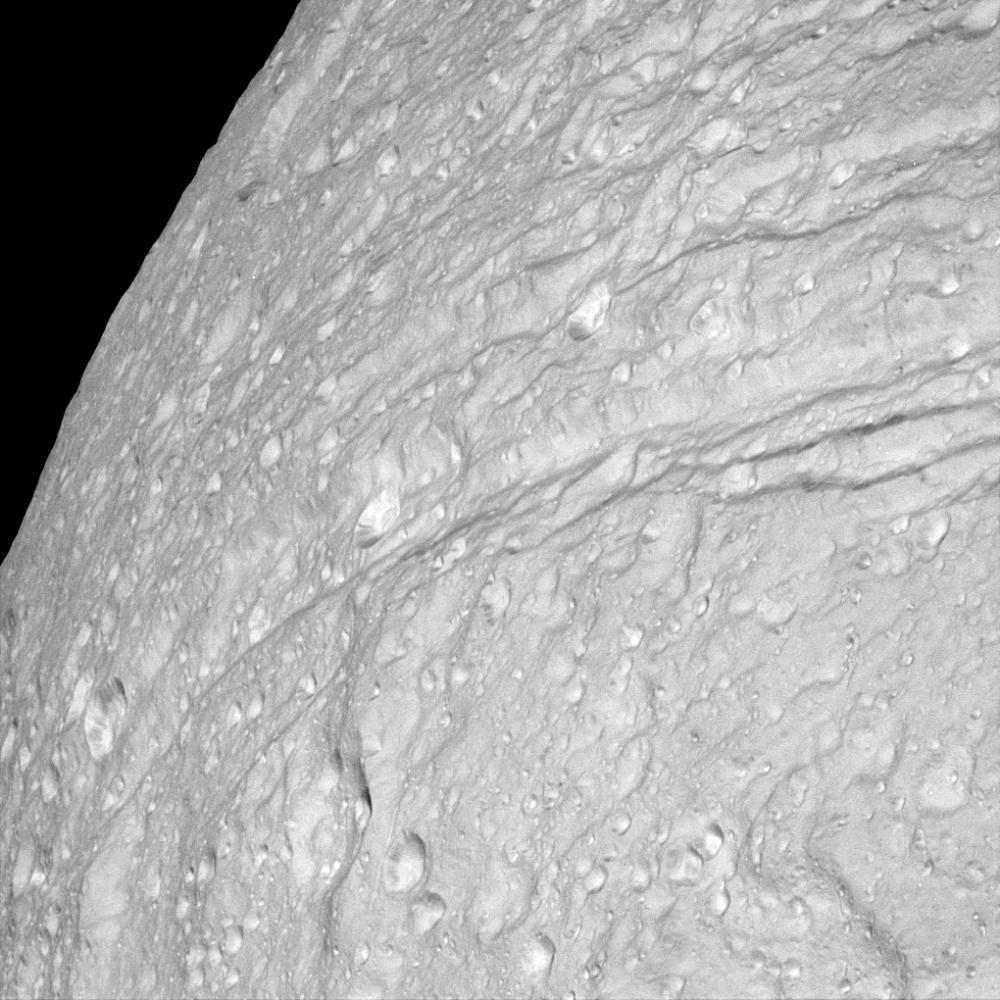
Tethys's Steep Scarps
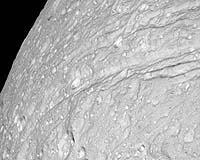
This view of the surface of Saturn's moon Tethys, taken during Cassini's close approach to the moon on Sept. 24, 2005, reveals an icy land of steep cliffs. The view is of the southernmost extent of Ithaca Chasma, in a region not seen by NASA's Voyager spacecraft. The ridges around Ithaca Chasma have been thoroughly hammered by impacts. This appearance suggests that Ithaca Chasma as a whole is very old. There is brighter material in the floors of many craters on Tethys. That's the opposite situation from Saturn's oddly tumbling moon Hyperion, where dark material is concentrated in the bottoms of many craters. This view is centered on terrain at approximately 2.5 degrees south latitude and 352 degrees west longitude on Tethys. North on Tethys is toward the right in this view. This clear filter view was obtained using the Cassini spacecraft narrow-angle camera at a distance of approximately 32,300 kilometers (20,000 miles) from Tethys and at a Sun-Tethys-spacecraft, or phase, angle of 20 degrees. Image scale is 190 meters (620 feet) per pixel.
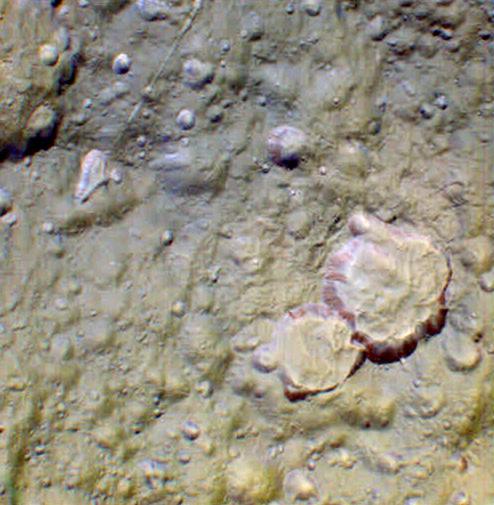
'Hi-Res' on Tethys - False Color
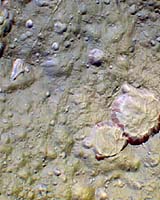
Tethys was previously known to have color differences on its surface, especially on its trailing side, but this kind of color diversity is new to imaging scientists. For a clear-filter view of this terrain, see here. This view is centered on terrain at approximately 4.2 degrees south latitude and 357 degrees west longitude on Tethys. The view has been rotated so that north on Tethys is up. The images for this view were obtained using the Cassini spacecraft narrow-angle camera at distances ranging from approximately 18,400 to 19,000 kilometers (11,400 to 11,800 miles) from Tethys and at a Sun-Tethys-spacecraft, or phase, angle of 17 degrees. Image scale is 213 meters (700 feet) per pixel. Related Links Cassini-Huygens at JPL Cassini Imaging Team SpaceDaily Search SpaceDaily Subscribe To SpaceDaily Express  Saturn's Spongy Hyperion
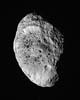 Pasadena CA (JPL) Sep 28, 2005
This photo was taken on September 25, 2005 and received on Earth September 26, 2005. The camera was pointing toward Hyperion at approximately 90,604 kilometers away, and the image was taken using the CL1 and CL2 filters.
|
|
| ||||||||||
| The content herein, unless otherwise known to be public domain, are Copyright 1995-2016 - Space Media Network. All websites are published in Australia and are solely subject to Australian law and governed by Fair Use principals for news reporting and research purposes. AFP, UPI and IANS news wire stories are copyright Agence France-Presse, United Press International and Indo-Asia News Service. ESA news reports are copyright European Space Agency. All NASA sourced material is public domain. Additional copyrights may apply in whole or part to other bona fide parties. Advertising does not imply endorsement, agreement or approval of any opinions, statements or information provided by Space Media Network on any Web page published or hosted by Space Media Network. Privacy Statement All images and articles appearing on Space Media Network have been edited or digitally altered in some way. Any requests to remove copyright material will be acted upon in a timely and appropriate manner. Any attempt to extort money from Space Media Network will be ignored and reported to Australian Law Enforcement Agencies as a potential case of financial fraud involving the use of a telephonic carriage device or postal service. |