
 |
 |
 |
 |
 |
 |
 |
 |
 |
 |

| . |  |
. |
Hovering Over Titan
A mosaic of nine processed images recently acquired during Cassini's first very close flyby of Saturn's moon Titan on Oct. 26, 2004, constitutes the most detailed full-disc view of the mysterious moon. The view is centered on 15 degrees south latitude, and 156 degrees west longitude. Brightness variations across the surface and bright clouds near the south pole are easily seen. The images that comprise the mosaic have been processed to reduce the effects of the atmosphere and to sharpen surface features. The mosaic has been trimmed to show only the illuminated surface and not the atmosphere above the edge of the moon. The Sun was behind Cassini, so nearly the full disc is illuminated. Pixel scales of the composite images vary from 2 to 4 kilometers per pixel (1.2 to 2.5 miles per pixel). Surface features are best seen near the center of the disc, where the spacecraft is looking directly downwards; the contrast becomes progressively lower and surface features become fuzzier toward the outside, where the spacecraft is peering through haze, which washes out surface features. The brighter region on the right side and equatorial region is named Xanadu Regio. Scientists are actively debating what processes may have created the bizarre surface brightness patterns seen here. The images hint at a young surface with no obvious craters. However, the exact nature of that activity, whether tectonic, wind-blown, fluvial, marine or volcanic is still to be determined. The images comprising this mosaic were acquired from distances ranging from 650,000 kilometers (400,000 miles) to 300,000 kilometers (200,000 miles). Related Links Cassini-Huygens mission at JPL Cassini imaging team SpaceDaily Search SpaceDaily Subscribe To SpaceDaily Express  Saturn's Rhea - A Real Shiner
 Pasadena CA (JPL) Nov 23, 2004
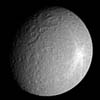
Saturn's moon Rhea shows off the moon equivalent of a black eye - a bright, rayed crater near its eastern limb. Rhea is about half the size of Earth's moon. At 1,528 kilometers (949 miles) across, it is the second-largest moon orbiting Saturn.
|
|
| |||||||||
| The content herein, unless otherwise known to be public domain, are Copyright 1995-2016 - Space Media Network. All websites are published in Australia and are solely subject to Australian law and governed by Fair Use principals for news reporting and research purposes. AFP, UPI and IANS news wire stories are copyright Agence France-Presse, United Press International and Indo-Asia News Service. ESA news reports are copyright European Space Agency. All NASA sourced material is public domain. Additional copyrights may apply in whole or part to other bona fide parties. Advertising does not imply endorsement, agreement or approval of any opinions, statements or information provided by Space Media Network on any Web page published or hosted by Space Media Network. Privacy Statement All images and articles appearing on Space Media Network have been edited or digitally altered in some way. Any requests to remove copyright material will be acted upon in a timely and appropriate manner. Any attempt to extort money from Space Media Network will be ignored and reported to Australian Law Enforcement Agencies as a potential case of financial fraud involving the use of a telephonic carriage device or postal service. |


