|
 |
 |
 |
 |
 |
 |
 |
 |
 |

| . |  |
. |
Saturn's Rings In Ultraviolet
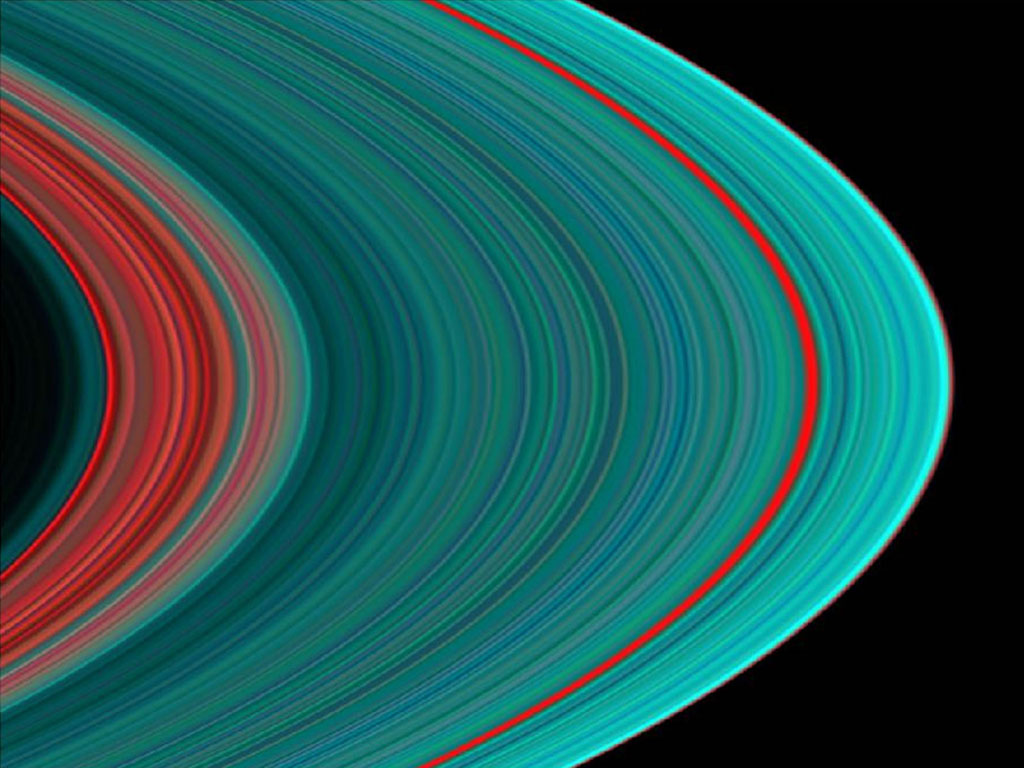
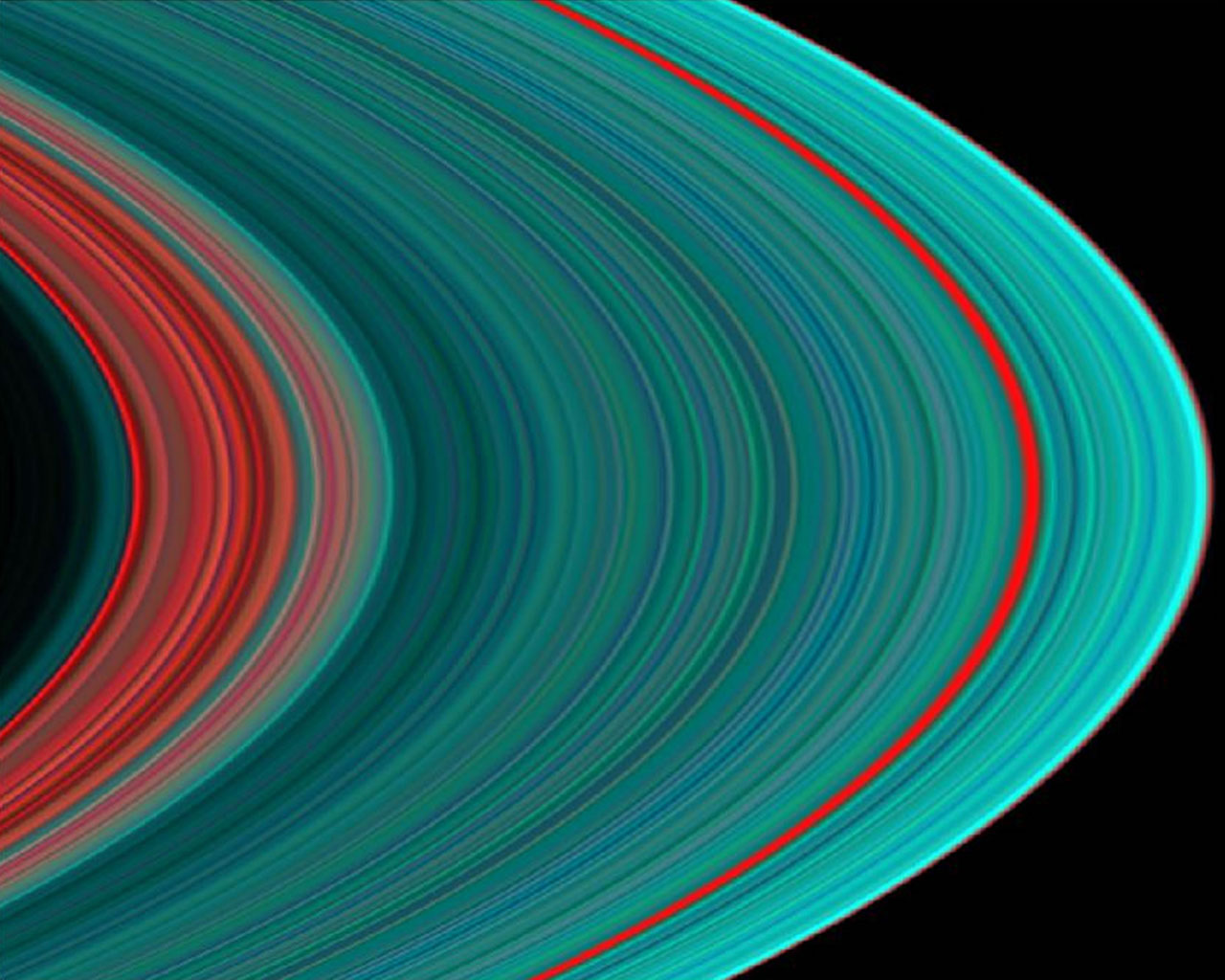
The best view ever of Saturn's rings in the ultraviolet indicates there is more ice toward the outer part of the rings, hinting at ring origin and evolution, say two University of Colorado at Boulder researchers involved in the Cassini mission. Researchers from CU-Boulder's Laboratory for Atmospheric and Space Physics, Joshua Colwell and Larry Esposito, said the UV spectra taken during the Cassini spacecraft's orbital insertion June 30 show definite compositional variation in the A, B and C rings. Esposito, who discovered the F ring around Saturn in 1979 using Pioneer 11 data, is the team leader for Cassini's Ultraviolet Imaging Spectrograph, or UVIS, a $12.5 million instrument riding on the spacecraft. A UVIS team member and ring expert, Colwell created the color-enhanced images from the spectra. The CU-Boulder built UVIS instrument is capable of resolving the rings to show features up to 60 miles across, roughly 10 times the resolution obtained by the Voyager 2 spacecraft. The instrument was able to resolve the "Cassini division," discovered by Giovanni Domenico Cassini in the 17th century, which separates the A and B rings of Saturn, proving the rings are not one contiguous feature. The ring system begins from the inside out with the D, C, B and A rings followed by the F, G and E rings. The red in both images indicates sparser ringlets likely made of "dirty," and possibly smaller, particles than in the denser, icier turquoise ringlets. Related Links Laboratory for Atmospheric and Space Physics at Boulder Uo Colorado, Boulder SpaceDaily Search SpaceDaily Subscribe To SpaceDaily Express  UV Images Of Rings Hint At Their Origin And Evolution
 Boulder CO (SPX) Jul 08, 2004
The best view ever of Saturn's rings in the ultraviolet indicates there is more ice toward the outer part of the rings, hinting at ring origin and evolution, say two University of Colorado at Boulder researchers involved in the Cassini mission.
|
|
| |||||||||
| The content herein, unless otherwise known to be public domain, are Copyright 1995-2016 - Space Media Network. All websites are published in Australia and are solely subject to Australian law and governed by Fair Use principals for news reporting and research purposes. AFP, UPI and IANS news wire stories are copyright Agence France-Presse, United Press International and Indo-Asia News Service. ESA news reports are copyright European Space Agency. All NASA sourced material is public domain. Additional copyrights may apply in whole or part to other bona fide parties. Advertising does not imply endorsement, agreement or approval of any opinions, statements or information provided by Space Media Network on any Web page published or hosted by Space Media Network. Privacy Statement All images and articles appearing on Space Media Network have been edited or digitally altered in some way. Any requests to remove copyright material will be acted upon in a timely and appropriate manner. Any attempt to extort money from Space Media Network will be ignored and reported to Australian Law Enforcement Agencies as a potential case of financial fraud involving the use of a telephonic carriage device or postal service. |