|
 |
 |
 |
 |
 |
 |
 |
 |
 |

| . |  |
. |
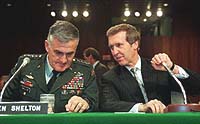
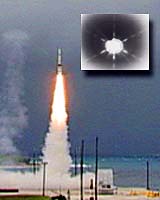
Washington (AFP) February 15, 2000 - The chairman of the Joint Chiefs of Staff dismissed concern here Tuesday that a June deadline for a decision on the deployment of a US missile defense system was premature. "From my perspective, I am comfortable with the June deadline," Shelton told journalists following a report that the Pentagon's top weapons' tester was asking for a delay. The Washington Post said Tuesday that a Pentagon report by its director of operational testing and evaluation, Philip Coyle, said the deadline was too early. "Undue pressure has been placed on the program to meet an artificial decision point," the Post quoted the report as saying. US President Bill Clinton will decide on whether to build by 2005 the controversial multi-billion dollar system conceived to knockout warheads targeting the continental United States. Deployment of the missile shield would require renegotiation of the 1972 Anti-Ballistic Missile treaty with Russia, which Moscow has so far refused. Clinton will base his judgement on the Pentagon's own assessment of the feasibility of building the system, dubbed National Missile Defense (NMD), by 2005. The Pentagon has twice tested its missile interceptor technology, recording one success and one failure. A third test is planned for May. "We recognize the NMD is a very high-risk program," said Shelton. "We are on a fast track and it carries with it a very high degree of risk in terms of keeping it right." But he said that Pentagon technical experts will by June be in a position to advise on whether the system should be deployed. Washington has justified the plan to build the system as a means of defense against rogue states that have or are acquiring missiles capable of striking the continental United States , most frequently citing North Korea.
Copyright 1999 AFP. All rights reserved. The material on this page is provided by AFP and may not be published, broadcast, rewritten or redistributed.
MILSPACE
|
|
| |||||||||
| The content herein, unless otherwise known to be public domain, are Copyright 1995-2016 - Space Media Network. All websites are published in Australia and are solely subject to Australian law and governed by Fair Use principals for news reporting and research purposes. AFP, UPI and IANS news wire stories are copyright Agence France-Presse, United Press International and Indo-Asia News Service. ESA news reports are copyright European Space Agency. All NASA sourced material is public domain. Additional copyrights may apply in whole or part to other bona fide parties. Advertising does not imply endorsement, agreement or approval of any opinions, statements or information provided by Space Media Network on any Web page published or hosted by Space Media Network. Privacy Statement All images and articles appearing on Space Media Network have been edited or digitally altered in some way. Any requests to remove copyright material will be acted upon in a timely and appropriate manner. Any attempt to extort money from Space Media Network will be ignored and reported to Australian Law Enforcement Agencies as a potential case of financial fraud involving the use of a telephonic carriage device or postal service. |