|
 |
 |
 |
 |
 |
 |
 |
 |
 |

| . |  |
. |
NASA Observatory Confirms Black Hole Limits
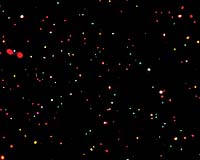
The very largest black holes reach a certain point and then grow no more. That's according to the best survey to date of black holes made with NASA's Chandra X-ray Observatory. Scientists also discovered previously hidden black holes well below their weight limit. These new results corroborate recent theoretical work about how black holes and galaxies grow. The biggest black holes, those with at least 100 million times the mass of the sun, ate voraciously during the early universe. Nearly all of them ran out of "food" billions of years ago and went onto a forced starvation diet. On the other hand, black holes approximately 10 to 100 million solar masses followed a more controlled eating plan. Because they took smaller portions of their meals of gas and dust, they continue growing. "Our data show some super massive black holes seem to binge, while others prefer to graze," said Amy Barger of the University of Wisconsin and University of Hawaii. Barger is lead author of the paper describing the results in the latest issue of The Astronomical Journal. "We understand better than ever how super massive black holes grow." One revelation is there is a strong connection between the growth of black holes and the birth of stars. Previously, astronomers had done careful studies of the birthrate of stars in galaxies but didn't know as much about the black holes at their centers. "These galaxies lose material into their central black holes at the same time they make their stars," Barger said. "So whatever mechanism governs star formation in galaxies also governs black hole growth." Astronomers made an accurate census of both the biggest, active black holes in the distance, and the relatively smaller, calmer ones closer to Earth. Now, for the first time, the ones in between have been properly counted. "We need to have an accurate head count over time of all growing black holes if we ever hope to understand their habits, so to speak," said co-author Richard Mushotzky of NASA's Goddard Space Flight Center, Greenbelt, Md. This study relied on the deepest X-ray images ever obtained, the Chandra Deep Fields North and South, plus a key wider-area survey of an area called the "Lockman Hole." The distances to the X-ray sources were determined by optical spectroscopic follow-up at the Keck 10-meter telescope on Mauna Kea in Hawaii, and show the black holes range from less than a billion to 12 billion light-years away. X-rays can penetrate the gas and dust that block optical and ultraviolet emissions. The very long-exposure images are crucial to find black holes that otherwise would go unnoticed. Chandra found many of the black holes smaller than about 100 million suns are buried under large amounts of dust and gas. This prevents detection of the optical light from the heated material near the black hole. The X-rays are more energetic and able to burrow through this dust and gas. However, the largest of the black holes show little sign of being obscured by dust or gas. In a form of weight self-control, powerful winds generated by the black hole's feeding frenzy may have cleared out the remaining dust and gas. Related Links Chandra at Harvard Chandra at NASA SpaceDaily Search SpaceDaily Subscribe To SpaceDaily Express  Simulations Show How Growing Black Holes Regulate Galaxy Formation
 Garching, Germany (SPX) Feb 10, 2005
Using a new computer model of galaxy formation, researchers have shown that growing black holes release a blast of energy that fundamentally regulates galaxy evolution and black hole growth itself.
|
|
| |||||||||
| The content herein, unless otherwise known to be public domain, are Copyright 1995-2016 - Space Media Network. All websites are published in Australia and are solely subject to Australian law and governed by Fair Use principals for news reporting and research purposes. AFP, UPI and IANS news wire stories are copyright Agence France-Presse, United Press International and Indo-Asia News Service. ESA news reports are copyright European Space Agency. All NASA sourced material is public domain. Additional copyrights may apply in whole or part to other bona fide parties. Advertising does not imply endorsement, agreement or approval of any opinions, statements or information provided by Space Media Network on any Web page published or hosted by Space Media Network. Privacy Statement All images and articles appearing on Space Media Network have been edited or digitally altered in some way. Any requests to remove copyright material will be acted upon in a timely and appropriate manner. Any attempt to extort money from Space Media Network will be ignored and reported to Australian Law Enforcement Agencies as a potential case of financial fraud involving the use of a telephonic carriage device or postal service. |