|
 |
 |
 |
 |
 |
 |
 |
 |
 |

| . |  |
. |
JPL Navigators Critical For Four Year Comet Tour Across Deep Space
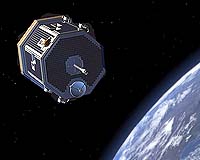
NASA's Comet Nucleus Tour launched July 3, will rely on the Jet Propulsion Laboratory's navigation team to guide the craft on its tricky journey toward two comets to find out how the icy, rocky bodies evolve as they approach the Sun. The spacecraft is poised for a 15-month journey to Comet Encke followed by a two-and-a-half-year trip to Comet Schwassmann-Wachmann 3. The mission was conceived so that scientists could compare the older, less active Encke to the younger, dust-clouded Schwassmann-Wachmann 3. The different targets pose a challenge to the navigators, too. "We'll be flying by quickly and close to Comet Encke. There will be just ten minutes of time to take the science data, and our job is to protect that time," said Tony Taylor, chief of the navigation team at JPL, in Pasadena, Calif. "On the other hand, Comet Schwassman-Wachmann 3 has more dust and gas shooting from its inner body. We will fly past it a bit farther away to avoid being hit by a particularly large particle, and we'll have more time to observe the comet." The navigation team will guide the spacecraft through its complex orbit. The complex launch plan will first send the spacecraft into an Earth-circling orbit. After six weeks, the navigators will steer the spacecraft toward the first of the two comets. "It's like having two launches," said Dr. Bobby Williams, a member of the navigation team and the leader of the JPL navigation team that landed the Near Earth Asteroid Rendezvous spacecraft on the asteroid Eros in February 2001. "We have to fire a rocket to go into orbit around Earth and then about six weeks later fire another rocket to push the spacecraft out of Earth orbit." The spacecraft will fly by each comet at the peak of its activity as it approaches the Sun. During each encounter, the target comet will be well situated in the night sky for astronomers worldwide to make concurrent observations from the ground. Protected by its dust shield, the spacecraft will fly by each comet nucleus to within a distance of 100 kilometers (62 miles). The most intensive data taking will occur within a day or so of each encounter. The mission's design is flexible so that the spacecraft can be retargeted to intercept an unexpected comet visitor. If a "new" comet passes close enough to Earth's orbit, mission managers at the Johns Hopkins University Applied Physics Laboratory, Laurel, Md., will design a new flight path to take advantage of the opportunity to study the new comet. The JPL navigation team will then calculate the amount of fuel the spacecraft should burn, and for how long, to put it on the right path. JPL will also provide communications support through the Deep Space Network, the worldwide series of antennas that provide radio communications for all of NASA's interplanetary spacecraft. "JPL's participation is essential to making the mission happen," said Dr. Joseph Veverka, principal investigator and leader of the mission from Cornell University, Ithaca, N.Y. "We have to get the spacecraft very close to the comets and we have to communicate with the spacecraft � and we couldn't do those things without JPL. And one of the world's experts on comets, Dr. Don Yeomans of JPL, is part of our science team." Related Links Contour 2002 SpaceDaily Search SpaceDaily Subscribe To SpaceDaily Express  Genetic Algorithms 'naturally Select' Better Satellite Orbits
 West Lafayette - Oct 15, 2001
Some Earth-orbiting satellites will be able to keep in touch longer with controllers on the planet's surface thanks to computer programs that mimic Darwin's evolutionary model of survival-of-the-fittest.
|
|
| |||||||||
| The content herein, unless otherwise known to be public domain, are Copyright 1995-2016 - Space Media Network. All websites are published in Australia and are solely subject to Australian law and governed by Fair Use principals for news reporting and research purposes. AFP, UPI and IANS news wire stories are copyright Agence France-Presse, United Press International and Indo-Asia News Service. ESA news reports are copyright European Space Agency. All NASA sourced material is public domain. Additional copyrights may apply in whole or part to other bona fide parties. Advertising does not imply endorsement, agreement or approval of any opinions, statements or information provided by Space Media Network on any Web page published or hosted by Space Media Network. Privacy Statement All images and articles appearing on Space Media Network have been edited or digitally altered in some way. Any requests to remove copyright material will be acted upon in a timely and appropriate manner. Any attempt to extort money from Space Media Network will be ignored and reported to Australian Law Enforcement Agencies as a potential case of financial fraud involving the use of a telephonic carriage device or postal service. |