|
 |
 |
 |
 |
 |
 |
 |
 |
 |

| . |  |
. |
JAXA Says Probe Touched Down On Asteroid
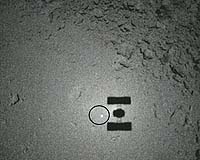
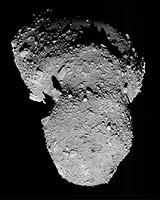
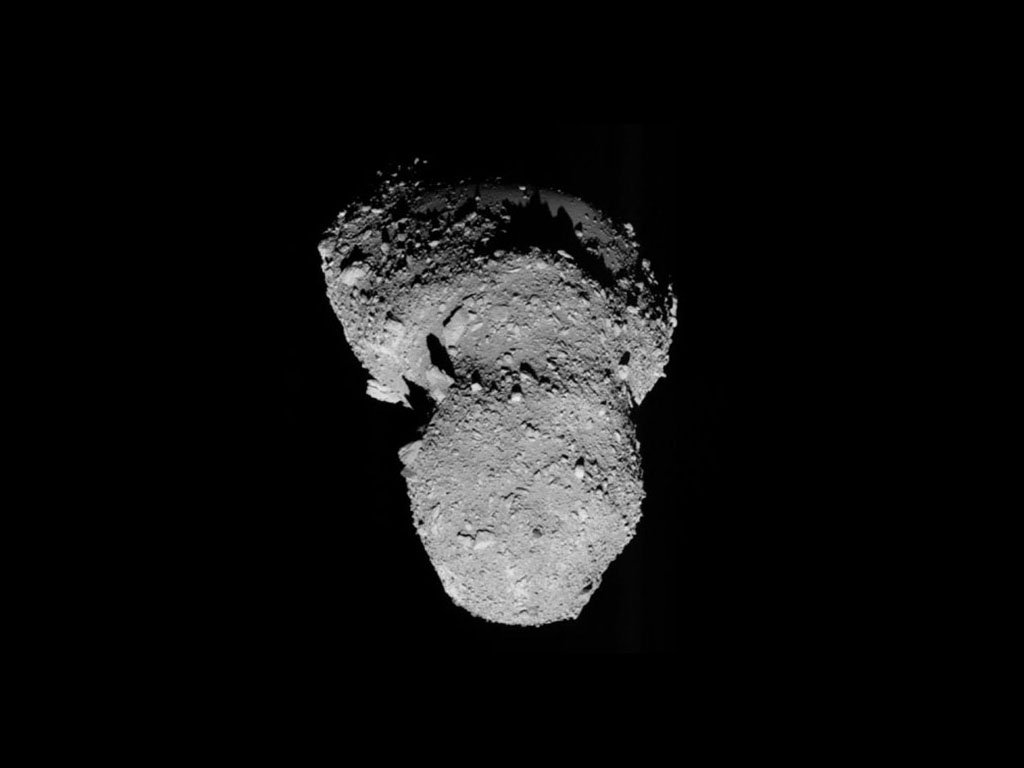
A Japanese spacecraft successfully touched down on an asteroid as part of a landmark mission, but failed to drop equipment to collect samples, Japan's space agency said Wednesday. The Japan Aerospace Exploration Agency (JAXA) had previously said that the attempted landing on Sunday failed after the Hayabusa space probe suffered a glitch and was unable to confirm its altitude. However, the agency said in an update that the spacecraft in fact managed to touch down on the bean-shaped Itokawa asteroid, located 290 million kilometers (180 million miles) from Earth for about 30 minutes, Kyodo News reported. It was the first landing by a Japanese space vehicle on an astronomic object, the agency said. JAXA will decide Thursday whether to make a second attempt to land Hayabusa. Although the body of the probe has not suffered any major damage, some of its censors need to be checked, the agency said. If the mission succeeds it would be the first time that material from an asteroid is brought to Earth, and could help scientists learn more about how the solar system was created. JAXA said last Friday that the spacecraft had released a "target marker", a small metal ball, 40 meters (132 feet) from the asteroid to mark the point where the six-meter spacecraft would gather rock and sand from the 500-metre-wide celestial body.
The spacecraft was also meant to leave an aluminium plate bearing the names of 880,000 people from 149 countries, among them US filmmaker Steven Spielberg and British science fiction author Arthur C. Clarke, on the asteroid. The agency also earlier lost contact with a micro-rover released from Hayabusa after the small robot failed to land on the asteroid. The robot, called Minerva and weighing less than 600 grams (21 ounces), was designed to investigate the surface of the asteroid with three small cameras. Hayabusa was launched in May 2003 with a budget of 12.7 billion yen (just over 100 million dollars) and is scheduled to return to Earth in June 2007. All rights reserved. � 2005 Agence France-Presse. Sections of the information displayed on this page (dispatches, photographs, logos) are protected by intellectual property rights owned by Agence France-Presse. As a consequence, you may not copy, reproduce, modify, transmit, publish, display or in any way commercially exploit any of the content of this section without the prior written consent of Agence France-Presse. Related Links SpaceDaily Search SpaceDaily Subscribe To SpaceDaily Express  Japanese Spacecraft Fails To Touch Down On Asteroid
 Tokyo (AFP) Nov 20, 2005
A Japanese spacecraft on Sunday failed to land on an asteroid in the second setback for the landmark mission aiming to bring samples from such a celestial body to Earth for the first time.
|
|
| ||||||||||
| The content herein, unless otherwise known to be public domain, are Copyright 1995-2016 - Space Media Network. All websites are published in Australia and are solely subject to Australian law and governed by Fair Use principals for news reporting and research purposes. AFP, UPI and IANS news wire stories are copyright Agence France-Presse, United Press International and Indo-Asia News Service. ESA news reports are copyright European Space Agency. All NASA sourced material is public domain. Additional copyrights may apply in whole or part to other bona fide parties. Advertising does not imply endorsement, agreement or approval of any opinions, statements or information provided by Space Media Network on any Web page published or hosted by Space Media Network. Privacy Statement All images and articles appearing on Space Media Network have been edited or digitally altered in some way. Any requests to remove copyright material will be acted upon in a timely and appropriate manner. Any attempt to extort money from Space Media Network will be ignored and reported to Australian Law Enforcement Agencies as a potential case of financial fraud involving the use of a telephonic carriage device or postal service. |