|
 |
 |
 |
 |
 |
 |
 |
 |
 |

| . |  |
. |
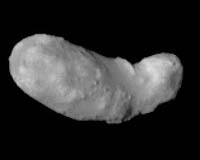
Latest Itokawa Image Reveals A Strange Asteroid With Few Craters
Hayabusa continues approaching Itokawa, and its image is growing day by day. This image was taken at 15:00 UTC on September 10 by the visible imager, AMICA. The distance now from Hayabusa to Itokawa is approximately 30km. Hayabusa is now 0.3 billion kilometres from Earth. At this distance, even light takes about 17 minutes to travel, so if Hayabusa needed an emergency instruction from Earth, it would not reach the probe in time. Therefore, Hayabusa is designed to pilot itself: to use the on-board camera and laser to read the asteroid's geography and judge when to approach it and where to land.
Sample collection It is impossible to land and stick to an asteroid with very low gravity, so the contact lasts only one second. During this brief contact, Hayabusa will fire a 5-gram metal ball at the surface, at a speed of 300 metres per second, and collect pieces stirred up by the impact. This is a revolutionary method for dealing with an asteroid with low gravity. The robot Minerva will detach from Hayabusa, land on Itokawa, and survey it while moving around its surface. Moving around on wheels works only when gravity is present, so a probe with wheels is of no use on Itokawa. Minerva travels by leaping, using its own momentum by accelerating a weight inside itself. This is an entirely new idea. Minerva will use its camera to take images of Itokawa's surface and also read its temperature.
Sample retrieval Until now, similar capsules or probes have entered the Earth's orbit first, and then re-entered the atmosphere once their speed was reduced. These capsules used different kinds of fuel and propulsion devices than Hayabusa, which, because of its smaller and lighter body, can re-enter the atmosphere directly. The capsule will enter the atmosphere at a speed of 12 kilometres per second, heating up to 3000�C. To keep it from burning up, a new material was developed specially for it. The capsule is scheduled to land in the Australian desert. Related Links Hayabusa at JAXA SpaceDaily Search SpaceDaily Subscribe To SpaceDaily Express  Largest Asteroid May Be 'Mini Planet' With Water Ice
 College Park MD (SPX) Sep 08, 2005
Observations of 1 Ceres, the largest known asteroid, have revealed that the object may be a "mini planet," and may contain large amounts of pure water ice beneath its surface.
|
|
| |||||||||
| The content herein, unless otherwise known to be public domain, are Copyright 1995-2016 - Space Media Network. All websites are published in Australia and are solely subject to Australian law and governed by Fair Use principals for news reporting and research purposes. AFP, UPI and IANS news wire stories are copyright Agence France-Presse, United Press International and Indo-Asia News Service. ESA news reports are copyright European Space Agency. All NASA sourced material is public domain. Additional copyrights may apply in whole or part to other bona fide parties. Advertising does not imply endorsement, agreement or approval of any opinions, statements or information provided by Space Media Network on any Web page published or hosted by Space Media Network. Privacy Statement All images and articles appearing on Space Media Network have been edited or digitally altered in some way. Any requests to remove copyright material will be acted upon in a timely and appropriate manner. Any attempt to extort money from Space Media Network will be ignored and reported to Australian Law Enforcement Agencies as a potential case of financial fraud involving the use of a telephonic carriage device or postal service. |