|
 |
 |
 |
 |
 |
 |
 |
 |
 |

| . |  |
. |
Ariane 5 Upper Stage Fails To Deliver Twin Birds To GEO
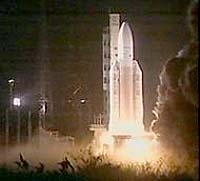
A European and a Japanese satellite have been placed in to the wrong orbit following a malfunction in the last stage of their launch by an Ariane-5 heavy rocket, Arianespace chairman and CEO Jean-Marie Luton said Friday. Liftoff from Europe's Spaceport in Kourou, French Guiana, at 2358 GMT Thursday, seemed normal but due to "a propulsion problem", the final stage of the rocket failed to place its two satellites on the designated trajectory. Therefore rather than being placed into their planned geostationary orbits the two satellites are in much lower orbits. "We are apologising to our clients," said Luton, who was speaking in Kourou in a direct link up with the headquarters of Arianespace, the European Space Agency's marketing arm, at Evry, near Paris. The major item on the payload was a 3.1-tonne European satellite, Artemis, (Advanced Relay and Technology Mission Satellite) that was to provide high-speed linkage between scientific and Earth-monitoring satellites and provide mobile phone coverage in Europe, North Africa and the Middle East. The other package was a 1.3-tonne satellite, BSAT-2b, launched for its Japanese operator BSAT, designed to provide satellite TV across the Japanese archipelago. Analysis was underway to discover whether the satellites could be saved, he added. The experts were more optimistic about salvaging the US Artemis satellite which has two reignitable engines while the Japanese satellite has only one engine which can be switched on only once. Even if they were nudged back into the correct orbit the satellites are likely to have a life-span far lower than the planned ten years. Preliminary investigative results were to be released later Friday. An expert at the Evry centre said that the second stage of the launch, where the problem occurred, was actually a much simpler procedure than the first rocket stage. Most previous problems encountered by Ariane flights have been linked to the original launcher section. It was the seventh commercial launch of an Ariane-5, a heavyweight successor to the veteran Ariane-4. The Japanese satellite was part of a constellation of BSAT satellites, for which there are 16 million subscribers in Japan. Arianespace has a full orderbook for satellite and other launches, with 43 satellites to be placed in orbit and nine automatic transport vehicles to be sent to the orbiting International Space Station (ISS) in coming years. The next launch of a European rocket is fixed for August 23, when an Ariane-4 is due to send up the international Intelsat-902 telecoms satellite. Related Links Arianespace SpaceDaily Search SpaceDaily Subscribe To SpaceDaily Express  Arianespace To Launch French Military Bird
 Le Bourget - June 21, 2001
Alcatel Space has chosen Arianespace to orbit France�s new Syracuse III military communications satellite, signing a launch services contract in its role as program prime contractor on behalf of the French defense procurement agency.
|
|
| |||||||||
| The content herein, unless otherwise known to be public domain, are Copyright 1995-2016 - Space Media Network. All websites are published in Australia and are solely subject to Australian law and governed by Fair Use principals for news reporting and research purposes. AFP, UPI and IANS news wire stories are copyright Agence France-Presse, United Press International and Indo-Asia News Service. ESA news reports are copyright European Space Agency. All NASA sourced material is public domain. Additional copyrights may apply in whole or part to other bona fide parties. Advertising does not imply endorsement, agreement or approval of any opinions, statements or information provided by Space Media Network on any Web page published or hosted by Space Media Network. Privacy Statement All images and articles appearing on Space Media Network have been edited or digitally altered in some way. Any requests to remove copyright material will be acted upon in a timely and appropriate manner. Any attempt to extort money from Space Media Network will be ignored and reported to Australian Law Enforcement Agencies as a potential case of financial fraud involving the use of a telephonic carriage device or postal service. |