24/7 Space News
TIME AND SPACE
Quantum key method enables redundant storage of qubit data
illustration only

Quantum key method enables redundant storage of qubit data

by Clarence Oxford
Los Angeles CA (SPX) Jan 07, 2026

A team of researchers at the University of Waterloo have demonstrated a method to back up quantum information by encrypting qubits during copying, providing redundancy while remaining consistent with the no-cloning theorem.

Quantum computing stores and processes information in qubits, which can be implemented in individual electrons, photons, atoms, ions or tiny electrical currents.

Universities, industry and governments worldwide are investing heavily in technologies to control qubits and scale them into large, reliable quantum computers that could support applications in cybersecurity, materials science, medical research and complex optimization.

"This breakthrough will enable quantum cloud storage, like a quantum Dropbox, a quantum Google Drive or a quantum STACKIT, that safely and securely stores the same quantum information on multiple servers, as a redundant and encrypted backup," said Dr. Achim Kempf, the Dieter Schwarz Chair for Physics of Information and AI in the Department of Applied Mathematics at Waterloo.

Kempf described the work as an important step toward building quantum computing infrastructure while working within the constraint of the no-cloning theorem, which states that quantum information cannot be copied directly because of the delicate way quantum states encode data.

Kempf, who is also an associate at the Institute for Quantum Computing at Waterloo and an associate member of the Perimeter Institute, likened quantum information to splitting a password: if one person has the first half and another the second, neither can use it alone, but together they recover the valuable password.

In a similar way, qubits can share information collectively, and the amount of accessible information grows as more qubits are combined.

A single qubit holds limited information on its own, but when qubits are linked, they can store a large amount of information that becomes accessible only when the system is treated as a whole, a property known as quantum entanglement.

Kempf noted that 100 qubits can share information in 2^100 ways simultaneously, an amount of entangled information that exceeds what all current classical computers could store.

Despite this potential, the no-cloning theorem constrains routine practices from classical computing, such as copying data for sharing and creating backups, because there is no simple copy-and-paste operation for quantum states.

"We have found a workaround for the no-cloning theorem of quantum information," explains Dr. Koji Yamaguchi, who co-discovered the new method with Kempf while working as a post-doctoral researcher in Kempf's lab and who is now a research assistant professor at Kyushu University.

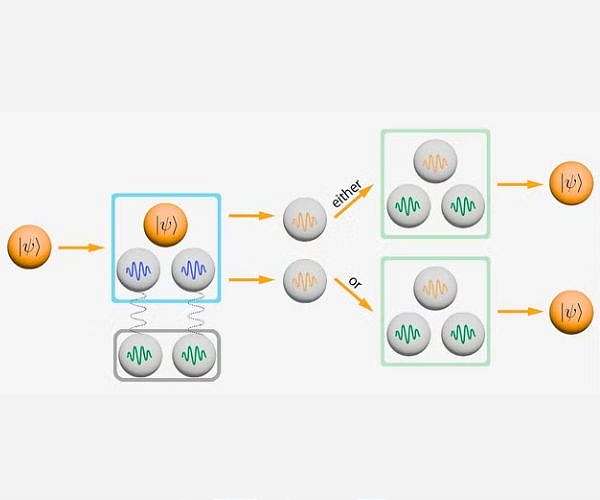
"It turns out that if we encrypt the quantum information as we copy it, we can make as many copies as we like. This method is able to bypass the no-cloning theorem because after one picks and decrypts one of the encrypted copies, the decryption key automatically expires, that is the decryption key is a one-time-use key. But even a one-time key enables important applications, such as redundant and encrypted quantum cloud services".

The protocol therefore enables many encrypted instances of the same quantum information to be distributed and stored, while ensuring that only one copy can be decrypted in practice because the key can only be used once.

The research, titled "Encrypted Qubits can be Cloned," was published in Physical Review Letters and presents a new approach for quantum networking and cloud-based quantum computing architectures that require secure, redundant quantum data storage.

Research Report: Encrypted Qubits can be Cloned

Related Links
University of Waterloo
Understanding Time and Space

Subscribe Free To Our Daily Newsletters
Tweet

RELATED CONTENT
The following news reports may link to other Space Media Network websites.
TIME AND SPACE
Hybrid detector array sharpens measurements of neutron rich nuclei lifetimes
Tokyo, Japan (SPX) Jan 06, 2026
Researchers from the Institute of Modern Physics and collaborating institutions have developed a hybrid detection system called HALIMA to measure the lifetimes of excited states in neutron rich nuclei produced by fission. Their study in Nuclear Science and Techniques describes how the array enables sub nanosecond lifetime measurements using a four fold FF/beta Ge LaBr3(Ce) LaBr3(Ce) coincidence technique. HALIMA integrates high resolution gamma spectroscopy with fast timing in one setup. Eight HPG ... read more

TIME AND SPACE
Startups go public in litmus test for Chinese AI

Sprawling CES gadgetfest a world stage for AI and its hype

Billionaire Trump nominee confirmed to lead NASA amid Moon race

ISS to change commanders before Soyuz crew leaves orbit

TIME AND SPACE
AI systems proposed to boost launch cadence reliability and traffic management

China debuts Long March 12A reusable rocket in Jiuquan test flight

Japan's flagship H3 rocket fails to launch satellite

Hydrogen from ethanol reforming mapped as aviation fuel-cell pathway

TIME AND SPACE
Wind-Sculpted Landscapes: Investigating the Martian Megaripple 'Hazyview'

HiRISE camera aboard Mars Reconnaissance Orbiter passes 100000 image milestone

Search for life should be top science priority for first human landing on Mars report says

Curiosity Blog, Sols 4750-4762: See You on the Other Side of the Sun

TIME AND SPACE
China harnesses nationwide system to drive spaceflight and satellite navigation advances

Shenzhou 21 crew complete eight hour spacewalk outside Tiangong station

Foreign satellites ride Kinetica 1 on new CAS Space mission

Experts at Hainan symposium call for stronger global space partnership

TIME AND SPACE
Time-expanded network model cuts complexity in mega constellation launch planning

Southern Launch to Host Lux Aeterna Re-Entries South Australia

Smart modeling framework targets 6G spectrum chaos in space air and ground networks

K2 Space raises 250m to scale Mega class high power satellites

TIME AND SPACE
From music to mind reading: AI startups bet on earbuds

New tool narrows the search for ideal material structures

Nostalgia and new fans as Tamagotchi turns 30

Chlorine and hydrogen from waste brines without external power

TIME AND SPACE
Clues to the migration path of hot Jupiters in their orbits

Hubble pinpoints asteroid smash ups in nearby Fomalhaut system

Evolution study finds history and environment shifts can steer species in very different directions

Webb maps carbon rich atmosphere on distorted pulsar planet

TIME AND SPACE
Uranus and Neptune may be rock rich worlds

SwRI links Uranus radiation belt mystery to solar storm driven waves

Looking inside icy moons

Saturn moon mission planning shifts to flower constellation theory

Subscribe Free To Our Daily Newsletters


The content herein, unless otherwise known to be public domain, are Copyright 1995-2024 - Space Media Network. All websites are published in Australia and are solely subject to Australian law and governed by Fair Use principals for news reporting and research purposes. AFP, UPI and IANS news wire stories are copyright Agence France-Presse, United Press International and Indo-Asia News Service. ESA news reports are copyright European Space Agency. All NASA sourced material is public domain. Additional copyrights may apply in whole or part to other bona fide parties. All articles labeled "by Staff Writers" include reports supplied to Space Media Network by industry news wires, PR agencies, corporate press officers and the like. Such articles are individually curated and edited by Space Media Network staff on the basis of the report's information value to our industry and professional readership. Advertising does not imply endorsement, agreement or approval of any opinions, statements or information provided by Space Media Network on any Web page published or hosted by Space Media Network. General Data Protection Regulation (GDPR) Statement Our advertisers use various cookies and the like to deliver the best ad banner available at one time. All network advertising suppliers have GDPR policies (Legitimate Interest) that conform with EU regulations for data collection. By using our websites you consent to cookie based advertising. If you do not agree with this then you must stop using the websites from May 25, 2018. Privacy Statement. Additional information can be found here at About Us.