|
 |
 |
 |
 |
 |
 |
 |
 |
 |

| . |  |
. |
BLAST Telescope Ready To Be Launched By Giant Balloon
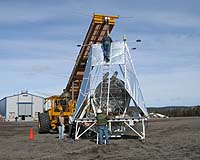
A spectacular balloon campaign is taking place at Swedish Space Corporation's operational base Esrange near Kiruna in northern Sweden. The time has come to launch the telescope BLAST to approximately 40 km altitude for a week-long flight from Esrange to North-western Canada. BLAST will be launched by a giant balloon (1.1 million m3), to collect unique and important scientific data as well as paving the way for many similar balloon campaigns planned for the future. For several years scientists from different university and institutes from the USA, Canada, United Kingdom and Mexico have been preparing this large and heavy (2000 kg) sub-millimetre-telescope for the launch scheduled for the end of May or beginning of June. The first possible launch day is May 25 (between 13.00 - 15.00) but this launch date is of course depending on weather conditions. BLAST Principal Investigator, Prof. Mark Devlin, University of Pennsylvania, says "BLAST will address some of the most important cosmological and galactic questions regarding the formation and evolution of stars, galaxies and clusters. "It makes use of bolometric arrays to achieve highly sensitivity images at three sub-millimetre wavelengths, while at the same time testing technology used in the future ESA sub-millimetre space telescope Herschel to be launched in 2007." Launch and flight operations for the unmanned, helium-filled balloon are conducted by the National Scientific Balloon Facility, Palestine, Texas, in cooperation with the Swedish Space Corporation's (SSC) balloon team at Esrange. NASA Wallops Flight Facility, Wallops Island, Va., manages the Balloon Program for the agency's Science Mission Directorate, Washington, D.C. Related Links SSC SpaceDaily Search SpaceDaily Subscribe To SpaceDaily Express  Russia To Orbit Radioastron Telescope
 Moscow (SPX) May 13, 2005
The Russian Federal Space Agency (Roscosmos) has announced plans to launch the Radioastron laboratory for observing extra-galactic objects in 2007, Vremya Novostei, a Russian daily has reported.
|
|
| |||||||||
| The content herein, unless otherwise known to be public domain, are Copyright 1995-2016 - Space Media Network. All websites are published in Australia and are solely subject to Australian law and governed by Fair Use principals for news reporting and research purposes. AFP, UPI and IANS news wire stories are copyright Agence France-Presse, United Press International and Indo-Asia News Service. ESA news reports are copyright European Space Agency. All NASA sourced material is public domain. Additional copyrights may apply in whole or part to other bona fide parties. Advertising does not imply endorsement, agreement or approval of any opinions, statements or information provided by Space Media Network on any Web page published or hosted by Space Media Network. Privacy Statement All images and articles appearing on Space Media Network have been edited or digitally altered in some way. Any requests to remove copyright material will be acted upon in a timely and appropriate manner. Any attempt to extort money from Space Media Network will be ignored and reported to Australian Law Enforcement Agencies as a potential case of financial fraud involving the use of a telephonic carriage device or postal service. |