|
 |
 |
 |
 |
 |
 |
 |
 |
 |

| . |  |
. |
NASA's Discovery Rolls To Major Return To Flight Milestone
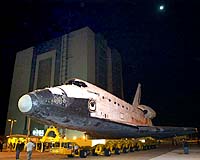
NASA's Space Shuttle Discovery is now one important step closer to launch with Discovery being moved from its hangar early Tuesday morning to the Vehicle Assembly Building (VAB). Discovery will be attached to its propulsion elements, a redesigned External Tank (ET) and twin Solid Rocket Boosters (SRBs), at NASA's Kennedy Space Center, Fla. "This is a tremendous accomplishment for the Space Shuttle Program," said Bill Parsons, Space Shuttle Program Manager. "This effort has taken a talented team dedicated to meticulously preparing the vehicle and implementing all the modifications for a safe Return to Flight," he added. Discovery's launch window is from May 15 to June 3. Its mission, designated STS-114, will take Commander Eileen Collins and six crew members to the International Space Station. The mission is the first of two test flights to check out new inspection and repair techniques, as well as to deliver supplies to the Station. It is the first Shuttle mission since the Columbia accident in February 2003. Discovery's journey began as it was moved from its hangar to the VAB. In the VAB, a lifting sling was attached to the orbiter in preparation for attachment to the ET and twin SRBs. Work on Discovery in the VAB includes installation of a new digital camera, testing electrical and mechanical attachments between the orbiter and ET and umbilical checks. "I could not be more proud of the team that spent the last two years working on Discovery. We are extremely excited to reach this point in the processing for flight," said Stephanie Stilson, NASA Vehicle Manager for Discovery. "Seeing the orbiter roll to the VAB is the culmination of all of that hard work. We look forward to a safe Return to Flight," she said. While in the Orbiter Processing Facility, Discovery underwent 41 modifications in response to the Columbia accident and the recommendations of the Columbia Accident Investigation Board. They included addition of the new Orbiter Boom Sensor System; equipping the orbiter with cameras and laser systems to inspect the Shuttle's Thermal Protection System (heat shield) while in space; sensors in the leading edge of the Shuttle's wings, a new safety measure that monitors the orbiter's wings for debris impacts; and a new digital camera to view the ET during launch. Discovery also completed its Orbiter Major Modification (OMM) period that began in September 2002. Technicians completed 107 additional modifications to Discovery, 17 will be flying for the first time. OMMs are scheduled at regular intervals to enhance safety and performance and to infuse new technology. The next Return to Flight milestone is scheduled early next week, when Discovery begins its four mile journey to Launch Pad 39-B. Dates and times are subject to change, and updates are available by calling: 321/867-2525. Related Links Return to Flight Improvements- Part 1 Return to Flight Improvements- Part 2 SpaceDaily Search SpaceDaily Subscribe To SpaceDaily Express  Discovery Getting Ready to Roll
 Cape Canaveral FL (SPX) Mar 28, 2005
When the crew members of the Space Shuttle Discovery lift off later this year from NASA's Kennedy Space Center, Fla., they'll be supported by two years of hard work by tens of thousands of people determined to make the Space Shuttle safer. NASA has upgraded flight hardware, as well as visual tracking and inspection equipment, to ensure the Return to Flight mission is successful.
|
|
| |||||||||
| The content herein, unless otherwise known to be public domain, are Copyright 1995-2016 - Space Media Network. All websites are published in Australia and are solely subject to Australian law and governed by Fair Use principals for news reporting and research purposes. AFP, UPI and IANS news wire stories are copyright Agence France-Presse, United Press International and Indo-Asia News Service. ESA news reports are copyright European Space Agency. All NASA sourced material is public domain. Additional copyrights may apply in whole or part to other bona fide parties. Advertising does not imply endorsement, agreement or approval of any opinions, statements or information provided by Space Media Network on any Web page published or hosted by Space Media Network. Privacy Statement All images and articles appearing on Space Media Network have been edited or digitally altered in some way. Any requests to remove copyright material will be acted upon in a timely and appropriate manner. Any attempt to extort money from Space Media Network will be ignored and reported to Australian Law Enforcement Agencies as a potential case of financial fraud involving the use of a telephonic carriage device or postal service. |