
 |
 |
 |
 |
 |
 |
 |
 |
 |
 |

| . |  |
. |
|
Air Force Advance Spaceplane Concepts by Frank Sietzen "SpaceCast News Service" 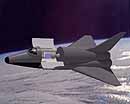 Washington DC, August 9, 1997 - Autumn drop tests at Hollomon Air Force Base in New Mexico will advance the U.S. Air Force research programs in defining designs and configurations for winged military vehicles capable of flying into space and deploying payloads with military applications and missions. But the concept will have to advance with little formal funding - and less top level approval for the actual development of an all-military spaceplane. Washington DC, August 9, 1997 - Autumn drop tests at Hollomon Air Force Base in New Mexico will advance the U.S. Air Force research programs in defining designs and configurations for winged military vehicles capable of flying into space and deploying payloads with military applications and missions. But the concept will have to advance with little formal funding - and less top level approval for the actual development of an all-military spaceplane.The tests, which will be conducted with a Boeing-built scale model of a winged spacecraft design, will be conducted in October by use of a Sikorsky helicopter as the inert, unmanned craft's carrier vehicle. The plan is to release the mini-spaceplane vehicle from beneath the chopper and allow the craft to perform landing operations. The tests come as the Air Force is refining mission roles and potential applications for fleets of reusable military spacecraft that would carry Air Force pilots and military satellites into space from a normal hard surface runway at any Air Force air base. While the spaceplane tests are to be conducted, the Air Force will issue a series of study contracts this fall to bring the concept further along. But Pentagon sources have told SpaceCast that the senior Air Force leadership is not yet ready to take the next step: requesting development funds, which could run into the hundreds of millions just for spacecraft prototypes. Boeing, McDonnell Douglas (soon to be a Boeing subsidiary), and Lockheed Martin will be bidding varied space vehicle designs as candidates for additional Air Force study. McDonnell Douglas is proposing a version of its wingless DC-X ballistic rocket technology demonstrator. Lockheed officials have confirmed they are proposing a military version of the NASA X-33 test craft. All designs would carry a single pilot and a small payload bay on a vehicle that would not actually orbit the Earth. Instead a new upper stage rocket - also under Air Force design at the Phillips Laboratory in Albuquerque N.M.- would fly the last way from the spaceplane's lower altitude into final orbit.
In addition to the obstacles offered by budget restrictions and technology research, the military spaceplane idea also faces a geopolitical one: several Capitol Hill sources have said that the existence of such a system could act as a weapons carrier -in violation of the existing U.S. and Russian arms control agreements, since the spaceplane's "payload" could easily be a nuclear warhead. Reuseable Launch Vehicle Archive at Spacer.Com
Rotary Kistler X-3X Other Space Planes General RLV Industry Issues
|
|
| ||||||||
| The content herein, unless otherwise known to be public domain, are Copyright 1995-2016 - Space Media Network. All websites are published in Australia and are solely subject to Australian law and governed by Fair Use principals for news reporting and research purposes. AFP, UPI and IANS news wire stories are copyright Agence France-Presse, United Press International and Indo-Asia News Service. ESA news reports are copyright European Space Agency. All NASA sourced material is public domain. Additional copyrights may apply in whole or part to other bona fide parties. Advertising does not imply endorsement, agreement or approval of any opinions, statements or information provided by Space Media Network on any Web page published or hosted by Space Media Network. Privacy Statement All images and articles appearing on Space Media Network have been edited or digitally altered in some way. Any requests to remove copyright material will be acted upon in a timely and appropriate manner. Any attempt to extort money from Space Media Network will be ignored and reported to Australian Law Enforcement Agencies as a potential case of financial fraud involving the use of a telephonic carriage device or postal service. |
